Showing posts with label Embedded operational knowledge. Show all posts

Sunday, September 4, 2016

Getting out from behind the desk/ control terminal requires aligned work

The above comment was made to me by an oil and gas company, and when I enquired to their expectation, it was clear that they wanted to empower "controllers" (operators) to be responsible for more. Enable decisions to be made faster while also gaining consistency across teams and shifts.

Transforming the traditional role of sitting in a control room behind a terminal, to a dynamic role, where the operator can get up and roam to investigate, make decisions and take actions in a timelier manner. This concept embraces all of the concepts this blog has raised over the last couple of months and shows the transition in the industrial sector to focusing operational empowerment.  

By unleashing the controller from their seat, they are free to investigate, see for themselves, and interact with others with experience to make informed decisions faster.

What is the reason why users have been locked to the desk/ control room, why has this transition not happened successfully before?

It is simple, the requirement to be monitoring the plant. A traditional control room is the central place alarms, notifications were traditionally piped.

So to free up the user, to leave the control room, the user needs to empowered with situational plant awareness, freed from monitoring, shifting to the experience of exception based notification. As the user roams the plant, the user is still responsible, and aware, and able to make decisions across the plant he is responsible for even if he not in view of that a particular piece of equipment. Driving the requirement for the mobile device the user carries to allow notification, drill thru access to information and ability to collaborate so the dependency to sit in the control room has lifted.


The second key part of the transformation/ enablement of a edge worker is that their work, tasks and associated materials can transfer with them. As the world moves to planned work, a user may start work task on a PC in the control room, but now move out to execute close action. As the user goes through the different steps, the associated material and actions are at his finders tips. The operational work can be generated , assigned and re directed from all terminal.s and devices.


So freeing up people is not just about providing mobile data taking the HMI Mobile. It requires the transformation to task based integrated operational environment where the "edge worker" is free to move.
System will notify him of situations, and he can take action, whilst also providing him with the opportunity to execute tasks. The information must free them to navigate with freedom, no matter the format, no matter where they start an activity, and have access to everything.   Why now? The technology is here with wireless plants, commodity devices to suite different applications/ roles, and the desire and culture to enable the flexible team, and design to enable exception based notification. The information, to knowledge systems are here to enable navigation through the required information while his situation changes. No longer are clients specific applications, they are role and situational based.
For all situations, freeing the anchors that hold people to the desk, and enable the reality of a flexible , empowered edge team. 


Sunday, May 22, 2016

What kind of a “driver” should the front-line worker be in the factory of the future?

This is a question I get asked a lot, and it is valid question. With the change roles, changing scopes of responsibility, and changing demographic / way of working, certainly the generic roles of the past 20 years will not work.
But getting back to the “driver” type of the future no matter role. So many people say why not eliminate drivers and humans all together, nothing new this is “lights out manufacturing” but is it practical. I believe not and the reason is the demanding world of today which demands change. 

Certainly where we have consistent planned know execution automation makes the whole sense, but :

  •         our product run sizes are reducing
  •          product change overs are increasing
  •          new product introduction is increasing
  •          Agility is key


The ability to absorb and handle change in operations, products and personal is becoming foundational in our operational system of the future.

Thursday, April 21, 2016

Is the day of User Guides / Manuals coming to end as Learning and Guides Merge???

I constantly work across teams, and companies, and listen now to challenge of the “dynamic workforce” that is rotating on sites and the challenge of “knowledge management/ transfer” constantly raises it’s self.
I was going to do a this weeks blog on a different topic, but a call this morning and one yesterday from engineering partners and customers around “knowledge transfer” and need to reduce the “time to experience” constantly comes up.  So I decided to chat about this challenge.
We have it within product development, how to transfer knowledge to field and set learning just does not work, so “self service” “E Learning is the big thing. But what the engineering house wanted to discuss was about their traditional project documentation, as they feel they waste a lot of time on documents that get out of date, and in many cases are not used.
This is again the same debate we have internally and I read in the forums as the traditional “User Guides” are giving way to videos, and then people debate what is the difference between E Learning, and user guides.
The question was asked why can’t our user question experience be short e learning's, and then if you have someone who wants to end to end learning these short E learning's and structured for a logical flow.
This is certainly where the software market is going, and seems logical for the Solution market. As the solutions developed on stand product need to evolve to solutions, the “learning experience” has to shift to in line, and native.

We have seen out operator training systems accelerate the retention, of data, and process for success. Shift to experiment and hands on, visual experience has an impact. This leads to the discussion of if video, recordings, , embedded simulation cases need to be part of the knowledge system.

Without a doubt “knowledge transfer” in our dynamic world is key, and maintaining the value of knowledge in a form that can easily consumed.
What is required is a knowledge system that:
·       Enables natural access in the context
·       Access remotely on different devices
·       Ability to easily add new knowledge and information.
·       Knowledge Management is key to tune, clean up knowledge, so the system is effective 5/ Rich search ability

The key here is an open system that enables crowd sourcing of information from many different roles, from within the company and from outside, but those who can contribute. The challenge in the industrial world traditionally contribution from roles was limited, this was due to main reasons;
·       The culture and atmosphere have not promoted the sharing, contribution
·       The systems did not enable natural, easy contribution, to one place that enables effective information.

Both of these factors are in transformation:
·       The systems / technologies are now available for knowledge, information systems to common, and easy to use and contribute. A notable example is Wikipedia that has millions of people contributing, and millions using. Key is it is simple to add new and extend knowledge posts from where ever you are. But they have a common hosted system, and they have a team of people reviewing and managing the information, so the system' s value is maintained. But I doubt the “word” is the best mode for rapid intake.

·       The culture of gen y is decidedly different to baby boomer even early gen x, they naturally search, share and contribute. Without this cultural transformation,  the concepts of Wikipedia and Facebook would not have worked, and grown to become such a natural part of the modern lifestyle.

It is time that the concepts of a Wikipedia / Youtube capability become a natural part of the industrial landscape, where the tagging of knowledge can provide the context and linkage with the supervisory system. The supervisory system must naturally call this knowledge system, passing context, and the natural ability to contribute and search.

All operational people no matter device should feel, like they do on Facebook, to add comment, capture events, capture experience from the system, and tag with context to increase search ability and use.
So will we have user guide/ solution manuals or will evolve to online learning, that is adhoc, and evolving vs a “snapshot” in time.

Sunday, April 10, 2016

Operational Continuity Foundation is Rapid / Early Decisions by Systems and People.

I was involved in an interview last week for an article in a magazine, like so many of these we had an expectation of the subject the editor wanted but as started it was clear that subject and expectations where different. Basically the editor wanted to understand about “big data” being applied in a particular industry, again it was someone with a technology concept the market is throwing about vs really understanding the business / operational challenge the industry is facing.


It did not take long for us to evolve the conversation into the number the main things companies must harness:

  • Operational Continuity: Maintaining their producing plants at the maximum output, with greatest efficiency, and best product margin
  • Agility: to supply the market with the correct product at the right quality, and right price and the right time in an every dynamic market
  • Asset Management/ Utilization: This is both fixed, mobile capital assets (non breathing assets, such as plants, trucks, ships) and the human assets (breathing assets). We find that as globalization increases the buying and selling of capital assets increasingly happen, introducing of challenge of  how do incorporate existing systems, automation, and practices into your overall value chain to provide the above “Operational Continuity” and “Agility”. Same when the asset is sold how you dis engage it cleanly especially with IP in the products and process. Combine this with the dynamic Human Asset landscape where human assets are moving regularly between plants and locations. Causing on a site not to have the required experience to make decisions, but people are in a role of having to make the decisions. YES the asset world for both capital assets and human assets is shifting form traditional stability in both classes for the last 20 years to one of both dynamic.

This comes back to conversation I started last week around “Achieving Consistent and Right Results in an Agile World” and the need for systems that have both:

  • Embedded knowledge and experience: key in this system is have a culture and system that naturally enables knowledge to captured and arranged, managed to be current and while native consumption of this knowledge is simple.
  • Augmented Collaboration of Experience: That in this dynamic world the need for a community of human assets of different experience in role and locations to contribute naturally to a decision in real time, augmenting the embedded knowledge. 


This calls for a system that enables people and systems, all of different levels of capability, and experience to work in coordinated way to reach a decision and act. The above diagram is a simple one of the core items of Action orientated Augmentation system.
Unconditional to success is:
  • Detect the situation requiring attention as early as possible, pin pointing the location and cause as best as we can. The traditional alarm, “as is” is too late. This does not apply just to process situations but also operational/ supply chain situations that effect “Operational Continuity”.
  • Understanding: This means the right person, or people, or system is notified with the required context of the situation. To often transitional systems are application based, so you alarm to control room, or SCADA system. There needs to shift to notify to people and roles, with acknowledgement of acceptance so that correct people are investigating and acting. Yes this will mean systems require unique logons, and shift to named users as people will be connected more, across applications and devices, and accountability in a team situation is fundamental so tasks do not get dropped. But core to understanding is the ability not to be just notified but to investigate, from the provided context the situation based on the workers experience, to collaborate fast with peers, and contribute an opinion.
  • Decide: Based on the incoming opinions from systems, and people, and raid decision can be determined based upon experience, knowledge, and technology. The decision could be made by a system or person based upon the inputs.
  • Actions: The appropriate actions and process to resolution can then taken across people (one or many) and across systems.

All the way along the system will rapidly manage the process of detect, understand, decide and act, and then track the success and increase the embedded knowledge. 
This is not a question of a new technology like "big data" it is about having a framework that works across your operational landscape to empower people, and systems to leverage existing knowledge and experience to evolve the Operational Success of the company.

Sunday, April 3, 2016

Achieving Consistent and Right Results in an Agile World

As Sunday draws to a close, I sit out looking over to pacific the waves crash, and birds fly, it is my time of reflection.

Last week I talked about some of the observations from the last month on the road. But this week I debated with a number of thought leaders and we all aligned on the challenge of a dynamic workforce, and dynamic operational/ business environment, means that chance of “Lights out Manufacturing “ are slim.

One company I was engaged with last week their thought pattern was still about replacing the personal on the plant, going to total automation. While I agree with automation, it is required for consistently and velocity of production. But I struggle with agility.

Two days latter I was at another company and they were all about empowerment of people, they wanted to automate process, and operations to free up people to add complimentary agility and “out of the box” thinking.  As one C level said to me, our market is changing as fast as we ever seen, and
Stepping back and looking at both these companies the second company was more automated than the first and the second was investing in automation more than the first. But their attitude was to gain consistently and free up people from repeatable tasks, and increase the responsibility of people, and empower people to make decisions fast.  


The diagram below really depicts what I started to introduce last week, and what this second company believed in.
That they needed to design their systems and people to play “natively in the dynamic world”, and they have realized that “embedded Intelligence and knowledge” will be key and must grow proportionally with increasing data. They also realized that with agility comes the changing operational environment and situations which will require “augmented intelligence” with the human brain can work out. The key thinkers in the industry are not looking to dependency on 1 to 2 people, they are leveraging the concept of “crowd sourcing” thru a active community of people. As we look at the operational/ automation world of the future the key pillars will be:

  •     Ability to capture knowledge and intelligence into the system to automate process, and operations. Key is this is not just traditional automation in PLCs/ DCS etc, it is capturing repeatable knowledge and decisions. So the system must bread a culture of contribution and use natively.
  •    Ability to have a community of workers who can share collaborated “naturally” with ease, no matter the location of the users and state. Foundational to this is  the ability trust the information, the measures so a common understanding of the situation, and basis for decision can be made.

Leading to natural decisions, and action paradigm across the team as seen below. I will expand on this more next week.


Sunday, October 4, 2015

Operational Windows Enable are a basis for Operational Management Experience (IOC)

I have talked about the drive by many companies to reduce “Operational Variation” across plants, teams, and industries. This is core to the journey to "operation excellence" gaining consistency, awareness and early detection of situations. When you look at the table below on the levels of human operational automation, the drive of the integrated operational experience is trying to reach level 5 "Worker management by exception", a big part of this is awareness of current operational process status relative to optimum.   


There are many ways that operational control will be implemented, as pointed out it could be through actions and processes becoming embedded and certainly this will be the big driver in the road to “Operational Innovation”.

But another way is through displaying key operational indicators to a knowledge worker, where  these indicators are mapped within boundary conditions. These boundaries are set up based on the time and relevance to the role and activity/ task the knowledge worker is performing. This sort of “operating Window” enables the knowledge worker the context, and recommendations, knowledge to enable operational decisions in a timely and ever consistent way. This same operational window can be used over multiple sites/ and teams for that role and activity providing consistency control.
The figure below is an example of an operational window.


Where on the left you can see the operational running trend, but you can see the changing boundary conditions of operation based upon product etc., The green shows the area where optimum control, safety, and production performance is. The right hand side you have reasons, and number instances of deviations for periods out of operational control.


Placing this sort of operational window where the operational boundaries come from the business strategy but in context of the role and activity no matter where in the plant operational team, but the feedback and running side is real-time from the plant. This window is place adjacent to  current control/ HMI screens the operator is using, or the maintenance or process screens the users are working, and you start the transformation to a knowledge worker. 


Sunday, September 27, 2015

The Changing Landscape of Supervisory Systems from HMI, / Common Control Room, to “Distributed Multi Point Operational Landscapes” !!!!!

For the last couple of years we have seen the changing supervisory solutions emerging, that will require a rethink of the underlying systems, and how they implemented and the traditional HMI, Control architectures will not satisfy! Certainly in upstream Oil and Gas, Power, Mining, Water and Smart Cities we have seen a significant growth in the Integrated Operational Center (IOC) concept. Where multiple sites control comes back into one room, where planning and operations can collaborate in real-time. Initially companies just virtualize their existing systems back, and then they standardize the experience for operational alignment and effectiveness, and then they simulation, and model, not many have got to this last step.

But in the last couple of weeks I have sat in discussions where people talk about this central IOC, which is key. When you start peeling back the “day in the life of operations” the IOC is only the “quarterback” in a flexible operational team of different roles, contributing different levels of operational. Combined with dynamic operational landscape, where the operational span of control of operational assets, is dynamically changing all the time. The question is what does the system look like, do the traditional approaches apply?


When you look at the operational landscape below, you can see 100s of operational control points where humans will have to interact with the system, with different spans of control, and operational points will be manned and unmanned on regular basis.


Traditionally companies have used isolated (siloed) HMI, DCS workstation controls at the facilities, and then others at the regional operational centers and then others at the central IOC, and stitched them together. Now you add the dynamic nature of the business with changing assets, and now a mobile workforce we have addition operational stations that of the mobile (roaming worker). All must see the same state, with scope to their span of control, and accountability to control. 
Since the 1990’s, control system technology has enabled a flexible delivery of work, where workers can support both “normal” and “abnormal” situations from multiple locations, either in the same room or across the world.  This mechanism has to be reliable, easy to implement, and easy to maintain.  Some customers have applied this mechanism to more than 5 different “points of operation”, which range from equipment panels, mobile devices and local control rooms to regional and national operations centers.

The requirements have become the following:

  1.        “Transparency of Trusted Operational State”: with real-time operational actionable decisions becoming key, the ability to monitor, the system raise the situation automatically through operational, asset self-awareness. So there is transparency to whole operational landscape situational state.
  2.        “Point of operation”: the implementation must support a configuration where one of the multiple points of operation uniquely can operate, which includes responding to alarms.
  3.        Simultaneous “point of operation”: the implementation must also support a configuration where more than 1 worker can operate, which is rarely more than 2.
  4.        “Span of operation” flexibility: each “point of operation” can be an individual PID, start/stop or device, or it can be a broader “span” of operation.  This “span” must be assignable in a flexible manner, where the “span” can be adjusted to become narrower or broader.  Example conditions include night time or overhaul conditions for some operations.
  5.        Ownership visibility: each possible point of operation must have a simple and clearly visible indication that it doesn’t have ownership, and reinforced indication when it does have the ownership. Clear visibility across the operational landscape as who has point of control, and as a team accountability is understood to respond to the situation promptly.
  6.        Management of alarms: it is essential for safety, legal, environmental and health requirements that new alarms animate, suppress/shelve, annunciate and trigger display changes only at the point(s) of operation, and only the workers using the point(s) of operation can acknowledge or silence new alarms. This means all alarms from asset to process, operational, but scope of alarm responsibility is aligned with span of control, but as a team there are “no blind spots” and alarm, situational awareness is escalated based on responsiveness, and situation. Assumption of control, and someone doing something must be removed.
  7.        Manage of operational events across different points of operation;Example operators want to be able to set operational limits/events across different operations? How is this managed and governed?
  8.         IT/OT seamless integration;Operating, monitoring, trending, alarming and integration with other islands of information to enable the teams to make informed decisions.
  9.         Reliability, upgradable, cyber security, network architecture, cloud;
  10.      One problem cannot bring down the whole operations!!
  11.      Assignment of operation: an authorized worker must have an easy and reliable means to assign and adjust the spans of operation.  The following diagram shows examples of transferring the span of operation between a roving user, a local control room, and a remote operations center:


In the above diagram, Areas or Sites “A” through “D” require supervision by different users or by the same user in different locations.  This scenario also applies to multiple operations consoles or desks within the same room.  The span of operation varies with the operations situations.  The span of operation can overlap among multiple users and multiple locations.

We need one system, but multiple operational points, and layouts, awareness so the OPERATIONAL TEAM can operate in unison, enabling effective operational work. Below is a high-level diagram of the operational team by the situation, you will have multiple skills in each situation, people will move through the situational state, but the diagram shows the merging operational work characteristics.


This emerging dynamic multi-point operational landscape is big topic that I will explore over the next few weeks, as traditional thinking, traditional architectures, and traditional implementations will not enable the transformation in operational work needed to satisfy effective agile operations.


Sunday, September 20, 2015

Operational Innovation !! Technology is here but Culture Needs to Evolve!

“Operational Innovation” is a hidden objective of many companies, even if they do not know it, again this came home last week. Why is it hidden because it is not natural for innovation to driven from all parts of the business, companies have a habit of centralizing it? Actually we can all contribute to innovational improvement to the way to take on, execute our “jobs to be done” during the day.

Monday, June 1, 2015

Industrial Internet of Things, enables going beyond the 4 walls of a Plant, to Mobile Plant Supply Chain

The last two blogs on the “Cyber Physical and Operational Management Evolution” and “How do you Achieve Orchestration in Industrial Internet of Things without Managed Configurations and Standards?” have created a lot of activity in hits but also email discussions.
This is good to see as two years ago these subjects would have hardly moved the needle, and they real opportunities for leading companies to embrace to expand their capabilities beyond the four walls of their plant.

Again last week I was involved in a number of discussions around these topics and liked one of my South African collaborators discussing how we have all these rich applications and capabilities for the fixed process plants, WHY cannot we apply these same tools to “MOBILE PLANT”?  Now he was from mining and was launching into the extraction side of mining and how to optimize the asset utilization, but he really wanted to go beyond that “Operational Optimization”.
The targets are not about data, what I like he is putting real operational goals in place:
  • Operational Processes optimization, understand operational times vs expected times and analysis of areas to improve
  •  Asset utilization / optimization
  •  Energy and Fuel optimization

As he put we have platforms in the plants that abstract equipment below, and model these equipment so we can record, track their operations, and then apply operational process improvements, and built in operational process rules for the fixed plant. Now taking this to mobile these same platforms could be used but now across mobile equipment, so now we must record geographical data as core as location is key when using fuel, doing operational routes, and time is of essence. But the Delay accounting applications of today could be applied to these mobile equipment and we could then move beyond that to embedding operational best practices and operational behavior in the devices, and equipment to guide the operations to work within the “operational windows” of optimized performance.  


The diagram below shows a more detailed chart of maturities I mentioned last week. The concept of smart, to optimized and autonomous can only come with inbuilt operational strategies and practices that enable the orchestration I talked about last week.

Source ARC (arcweb.com).

The key is most of the mining extraction/ mobile plant is isolated, and I would say siloed even when connected between applications.

Remember the Industrial Internet of things is not about data, it is about “actionable decisions” in the NOW, by either machines, applications or people, and this will require embedded operational strategies/ processes that coordinate the mobile equipment to align with the overall business strategies.

If you are looking in the plant / fixed process world to apply IOT and gain significant value, you should think again and “open the door” and look outside the plant to mobile plant, or mobile supply chain, and extend the richness of operational applications to these traditionally isolated equipment and processes! 

Sunday, May 10, 2015

Increased Automation of Tasks/ Decisions over the next 10 Years is Foundational, but that does not mean “Lights out Manufacturing”.

In order to deal the increased complexity of the operational opportunity of today, the flat world of competition from around the globe, and the complexity of the Operational System, the production increase dramatically. Requiring higher qualified people, or take the approach that we must constantly simplify the operational experience, so the required skill level does not increase with the complexity of the Operational Scenarios the system is applied.

The diagram below shows the critical drive to sustain productivity margins, by increasing the productivity, while flattening the hourly rate for that productivity. This can only happen through increased effectiveness of the systems, and use of people, without adding more people, or requiring highly skilled people.

So many of the programs have this drive to increase automation of tasks, with some people jumping to the conclusion that means we moving to “lights out manufacturing” an old concept. That is not the case, we need the human brain to deal with the exception and edge decisions and actions where the model has not been created. With agility increasing velocity of products through the supply chain, while increasing the volume of new product introductions, combined with the complete value supply chain managed as one, the role of workers is key.
The table below shows one version of the 6 levels of automation. The key is as a decision and action become predictable and well known, then it must be rolled into the system as “knowledge “and “Wisdom”.

The goal is to get to “Manage by Exception” (level 5) vs all decisions, this is what is done in a aeronautical industry with pilot/ plane control, and is why it is key to take on principles like “situational awareness” so a worker is able to see the ever growing scope of responsibility, in an insistent.

Where does you design principles apply in this landscape?

Sunday, April 26, 2015

Participation architecture and culture key to Innovation

For the last couple of weeks I have been travelling in South Africa, visiting and talking with customers, and listening. But last week at I listened to a talk given by the Ex CEO of Google South Africa (Stafford Masie), and the core of the talk really resonated with what I have been talking about and seeing.

The key was the you need to open up your cultures and architectures to naturally allow participation in your companies evolution from members within the company and outside. Too often our traditional cultures and systems have closed the strategy, innovation of ideas to evolve companies’ offerings in products/ services to a few. But in the software industry we have developed programs that promote innovation from all corners of a company, Google does this using Friday’s for “my innovation”. Key is the culture to enable innovation and then the framework in the company for promoting ideas and selecting valuable ones to be invested in to be evolved.

Stafford Masie's thoughts took this a step further into general industrial space using examples where companies have opened up their products/ offerings to external groups to provide a different, free thought for evolving the offering, to enable certain break through.

In the past I have spoken about “Operational Innovation”, too often people look at innovation as purely technology, but I believe the greatest return on investment is on “operational innovation” in improving the operational processes and efficiency for producing products and services. Requiring companies to develop a culture and architecture that enables:

  • Capturing and understanding current operational processes. Across the industrial assets/ plants making certain products. Providing the opportunity for identification of common best practices, both inefficiencies and efficiencies.
  • Promotion of participation across the company from workers, operators and others to contribute operational improvement to processes they work on.
  • An architecture and environment where operational processes can be tested, in safe area, so innovation can happen through constructive failure and environment to promote trying. A good example of this is where people can try operational procedures in simulated situations and results captured. Something like an Operator Training System used for both training, and “operational innovation” is valuable environment for safe constructive operational process innovation.
  • An environment / architecture that allows ideas to improve to be entered there and then in the system, while the idea is “fresh” and context can be captured, but the idea result in evaluated and feedback to the contributor.

Below is a diagram I have commented on before but shows how companies that embedded process after a lean improvements program far exceed those who just manually implemented process improvement. But the real opportunity for improvement comes when people apply continuous operational innovation (red line). Not being content with their current process but have implemented abilities to understand process performances both machine to machine, people to people, and people to machine. Because they have embedded the operational procedure in the system, over multiple sites, they have everyone acting the same way, so improvement is possible.


Core to success in the next decade is the ability to evolve and innovate, and it is the companies that implement an architecture/ system and culture that promote participation that will be key. What are your plans in seating up a system to enable participation and evolution in a sustained manner?

Tuesday, February 24, 2015

Operational Practices, the associated activities, then impact on Roles provides the path towards Operational Excellence Design

Again the last 2 weeks in the USA speaking with customers the question of how they move forward towards 2020 where do we start. Too often I see people start from the easy place that of technologies and products, vs really understanding where they want to be in 2020/25. How will their run their plants, and operational practices across sites and supply chain at all levels is key. Once you know the operational processes you can determine the operational activities and effect on the roles in the company at that time, this will lead to the required solutions.

Companies have invested and executed on the tradition alignment in a plant across process systems, and business systems such as SAP, leveraging such guidelines as ISA 95. With the drive towards more and more agility and rapid deployment of products to markets, these alignments are key, but the other area of critical concern is the operational workplace. With the rapid agility, comes more alignment, and more complexity, combined with key / rapid decisions to be made, the operational team, and operational workspace will be critical. Combine this with the facts that over 10000 experienced baby boomers are retiring each week, and this rate is expected to continue for seventeen years, and that by 2020 the 42 workforce is expected to made up 42+%  
So where do you start when planning to design a system  What concerned me was the throwing of technologies around like cloud, wireless, and mobile, and looking for how, instead of stepping back and looking at what are they trying to achieve, and then applying technologies to that plan.
It is important to note that, in both cases, their automation layer is mature and well established and that their business side is also well thought through and well on the way to being established on the second generation business system.
Again the opportunity of significant improvement and gain in operational efficiency is at the operational layer across multiple facilities. Again the role of people and enabling decisions in real-time are key but not just decisions but a consistency in action in the operational control loop.
The question of where to start came up, and through the discussion the opportunity of stepping back and taking a look at the roles that an operational plant will require from the roles in 2020 to execute. These roles could be on site or off site, through the concept of the “flexible operational team”. Define the role, the day in the life of that role taking into account location, what decisions and actions that role is responsible for and who and what he will interact with through the day. Yes, switch into a “Facebook” thinking of friends, but friends maybe people, (other experts) Assets, Processes, even products. Once this map of a decisions and responsibilities during the day is defined, this drives what information, systems and people this role must interact with in a day. It will also determine what operational procedures (Operational Activities) the role will potentially engage.
This role map is key as now you have a starting point, as to driving consistency in a dynamically changing workforce. Combining these role map, composed of “operational activities” associated with the role, where the activity has the required notification, information, actions, community of expertise etc. and architectural landscape so these “operational activities” can compliment existing systems.
The architectural landscape should define the layers on top of existing systems, in a neutral way, where these operational activities (model driven approach) will reside, these could be local or remote hosting but will require clear governance and require models to defined in an environment that enables constant evolution of the practices but process experts locally and centrally as a “crowd development”, with governance control.
This focus on a role or set of key roles allows the company to focus on how the operational plant will run in 2020 and the key decisions that required, and start applying these now in an architecture that lives with the current systems, but starts to drive consistency and faster decisions across that same role over multiple plants. Notice I have not talked technologies, my assumption on mobile and cloud that the architecture is set up so these activities will be able to execute independently of the device, so the adoption of what devices are used on a plant are relative to plant and support they get, key is the devices no matter if desktop or mobile or web should be suited to efficiency of the role execution.

The clear opportunity is the linking of smart/ intelligent assets to people, and optimized process, and this is the essence of distributed industrial systems of the future on which “Internet of things’ / “Industrial internet” and the “third Industrial Revolution” are based. Key not getting overwhelmed with technology (it is here) it is the “job” or operational improvement that is the opportunity, and how to achieve this. A good starting point is understanding and achieving consistency in the key roles in the future vs the dynamically evolving workforce.

Sunday, January 4, 2015

Why Companies must Reduce Complexity!!!

Happy New Year to all of you. 2015 dawns over the water here, and I have a chance to review many articles and and time step back and think. That is what the holidays provide for me a time of family time and reflection and direction.
In the last half of 2014 we saw a significant increase in companies wanting, engaging with with us on "operational System, Operational Environment in 2020 - 25". These were not esquires these were real engagements where companies were reflecting on their systems relative to the new operational landscape we are all facing over the next 10 years.I suspect that 2015 will continue this trend and different programs been taken by companies to guide investments, and technological adoptions to provide them with a foundation to address "operational transformation". Certainly from with in Schneider _Electric we focused on this transformation, and accelerating platforms, Products, applications that will enable operational systems for 2020-25. Addressing the increasing complexity of systems, without increasing operational process complexity is fundamental.

But I thought I would start the new year blog with a great article that I read through the holidays on companies addressing complexity. One of challengers we all face is the new operational landscape with changing products, a flat world of competition and changing workforce, we have a tendency to
think and create complexity is increasing value. This article by Neil Smith allows a good "step back" of the need stay focused on simplicity and this must apply to operational processes and systems, if we are going to be able to absorb change and compete.
So have a read, and lets make sure we do not loose focus on this fundamental objective of simplicity is key to "operational excellence"!!

http://changethis.com/manifesto/95.06.ReduceComplexity/pdf/95.06.ReduceComplexity.pdf

Saturday, December 6, 2014

The Workforce Crisis of 2030!! And how to start solving it now

“People, workforce planning will become more important than financial planning.” Rainer Strack
This is a statement from good TED talk by Rainer on his interpretation of the workforce challenge of 2030. Supporting much of what this blog has been looking at this past year, but bringing another angle. The key we both trying to get over it is not about the changing workforce it is about the operational workforce transformation to a new workforce landscape of skill shortage, labor shortage and cultural and people change.

You can go to Ted talk with the following link.

http://www.ted.com/talks/rainer_strack_the_surprising_workforce_crisis_of_2030_and_how_to_start_solving_it_now

A couple of extractions:


The investigation and determination of a significant workforce shortage by 2030, but starting now:


The required strategies that will dominate much the thinking


Rainer is talking general workforce, if you take this and bring it into manufacturing, industrial world, the shortages will be all more acute. As pointed out in other surveys from Accenture and others.


This shows in US survey results on filling skilled and highly skilled roles, below is worked example of mid sized company in mid west.  


This is why the move from knowledge to wisdom is key, and emedding of knowledge and wisdom , actionable decisions into the systems is key to accommodate the transformation to dramatically reduced dependency on skilled people. From Rainer’s and other investigations that Operational Systems of the future in the industrial market have 50% + reduction in dependency in skilled and highly skilled workforce. This Ted talk supports this will be the biggest issue in the next 10 years to sustain competitive agility. Like we have seen in 2014, I believe 2015 this acknowledgment and strategies building around workforce change will intensify.    

Sunday, November 23, 2014

Convergence on Wisdom (applied Knowledge), and Industrial Analytics / Operation Intelligence grow in importance!!!

It seems like a while I have been talking about Operational Intelligence/ Industrial Analystics, and then the movment to Wisdom (Applied Knowledge) all as separate threads but I was asked the question last week:
 “how do they relate?” .
They are different, but all related to empowerment of operational workforce to make faster decisions, and take actions. As I pointed out last week one of the big drivers to platforms is to manage varience. We talk Supervisory, MES, Information, Simulation platforms, but as we pointed out must a “People Platform” that covers:
·         Collaboration between people
·         Supports the hosting of “Activities” with their embedded information/ knowledge and their associated actions.
·         Transformation of Information to Situation ally aware for the particular user interested/ interacting.
·         Management of Operational Work between team members
·         Notifications

·         Plus more


This will abstract the turnover of the workforce, abstracting the different skill levels, and experience levels, with embedded “Applied Knowledge (Wisdom),  so the experience is now in the system. A key concept for the this upcoming Operational Transformation.


Industrial Analytics provides the shift from the past through the present and into the future based on high fidelity models(from experience). Providing a new dimension to the workers tools, and thru the decision they are about to make. Combining the “Future”    providing answers to “what will happen!!!” with the recommended actions to take.
Providing the answer to “What should I do Next?” with experience, fore thought, and understanding. Operation Intelligence also aligns with this by providing a screens, presentation of the situation or “ know Questions” with context and awareness.


Operational Intelligence providing the worker an understanding of “Now” , where he is, and what the future holds, simple and clear. Increasingly I am being asked for this type of “Operational window” and view; it is not analysis it practical information around my current situation and immediate future. No configuration just a simple view of task or question provides the view and clear awareness, providing an answer.
Are these different experiences, No, they are all functional value expansions on each other, and should seen as building blocks in the road to providing and Operational Execution knowledge platform, with built in experience. Providing a foundation for absorbing turnover, transition in the workforce while maintaining operational consistency and efficiency.   

Sunday, September 7, 2014

Industrial Internet of Things: What does it mean to me?

I must have sat through 3 to four presentations of IoT in the last 2 weeks from different vendors, different industries. Combine this active strategic discussions within our development teams, you see many angles and thought approaches.

ARC’s definition:
“The industrial internet of things is a collection of technologies that can come together in a targeted  solution to improve business performance and machine availability”.

The key is the transition to information driven system has begun and it is about alignment of devices, process and people, to be effective in real-time agile production. Extending across the plant, and the whole value supply chain, providing transparency in end to end operations.


All are valid, but the question was asked on a site visit last week " what does it mean to us?". So I stood up and went to white board and drew three circles and intersected them, to represent the opportunity.

Tuesday, August 19, 2014

Knowledge must transfer to Industrial Systems to Combat the Skill Shortage/ Lack of Experts

A couple of weeks ago I talked about tacit knowledge and how it is key due changing way experts will be deployed, and short fall in skilled workforce. This was driven home again this week, with the release of skill assessment by “Accenture 2014 Manufacturing Skills and Training Study” that showed some real truths to the situation in the USA.
The diagram below show the current split of jobs that Highly skilled to skilled to unskilled, then the second shows that percentage of the Highly skilled and skilled jobs will grow over the next 2 years.

This is in total contradiction to the next set of questions around how severe is the skill shortage in customers.
The take away is that we putting in more complex processes, and systems in order to compete in the “flat world” which requires increased skilled people, yet there is reducing capacity in skilled, and highly skilled talent, actually the pool is shrinking.
The study goes on to talk about training and the use of operator training systems, and the need for intuitive (self learning) systems. But my thoughts rang back to discussion on Tacit Knowledge and how critical it is to capture experience not in words, or videos, but in systems that enable actionable decisions (built on embedded captured operational experience). Examples are Embedded operational Procedures, simulation for the future, pattern recognition on conditions to see events before they happen, all new techniques just entering the operational systems.  
Tacit knowledge is not easily shared. Although it is that which is used by all people, it is not necessarily able to be easily articulated. It consists of beliefs, ideals, values, schemata and mental models which are deeply ingrained in us and which we often take for granted. The key to acquiring tacit knowledge is experience. Without some form of shared experience, it is extremely difficult for people to share each other's thinking processes.
Tacit knowledge has been described as “know-how” – as opposed to “know-what” (facts), “know-why” (science), or “know-who” (networking). It involves learning and skill but not in a way that can be written down. On this account knowing-how or embodied knowledge is characteristic of the expert, who acts, makes judgments, and so forth without explicitly reflecting on the principles or rules involved. The expert works without having a theory of his or her work; he or she just performs skillfully without deliberation or focused attention. Apprentices, for example, work with their mentors and learn craftsmanship not through language but by observation, imitation, and practice.

The study goes on to provide examples of the impact of this shortage for a midsized $500m complaint to be $4.6m loss annually:
Food for thought!!! Tacit Knowledge must be captured in a form that new users can take actionable decisions in a reliable and effective way, through knowledge and experience moving from the experts to the systems in a sustainable approach that can evolve.

Sunday, July 20, 2014

Clear KPIs for Measuring “Smart Plant/ Factory” Success is Key, Again Operations, Humans are Difference in this 4th Industrial Revolution

I seem to have been involved in Smart Fields, Smart Facilities, etc for years, and a lot of the discussion and thought leadership was around information, and more intelligent devices. But many have had limited success, until now, why is because many “smart” strategies did not cover all the bases.

During last week a colleague and I had a number of workshop sessions around forward strategy, reviewing specifically what is different this time round with smart, looking at the “Operational Transformation” event we seeing unfold, what is different and core this time! It was very clear, but so was the significant discontinuity in the market.

When we talk Smart concepts too often, the discussions goes quickly to the “smart/ intelligent” devices, and data and information, with the hype around the “Internet of Things” this continues. But when you really get down to what people are trying to achieve is decisions faster, and flexibility / agility through awareness and operational transparency.  

Yes the real impact here of this Operational Transformation is not just that devices are becoming smarter, “self aware” but the need to gain consistency in operations, and reduce errors. There is significant discontinuity happen in the market, as the logical way to eliminate the errors is through experienced workforce. As we all know that actually the workforce in 5 years will dramatically be less experienced than the workforce of yesterday or today.


The diagram below shows the experienced workforce  today is responsible for most of the unscheduled shutdowns.
So the outlook in the next 5 years is grim as we move to the in experienced workforce, unless our systems and operational processes change that is why “smart xxx” is real.
The major outcomes of the drive towards “smart factories, airports, fields etc” is to embed the operational experience, and self awareness in the Smart Devices” and “Smart Processes” .

Too often we do not have clear goals, but it was interesting to see a leading coming define very clear goals constantly to monitor the direction, and success of this "journey". 

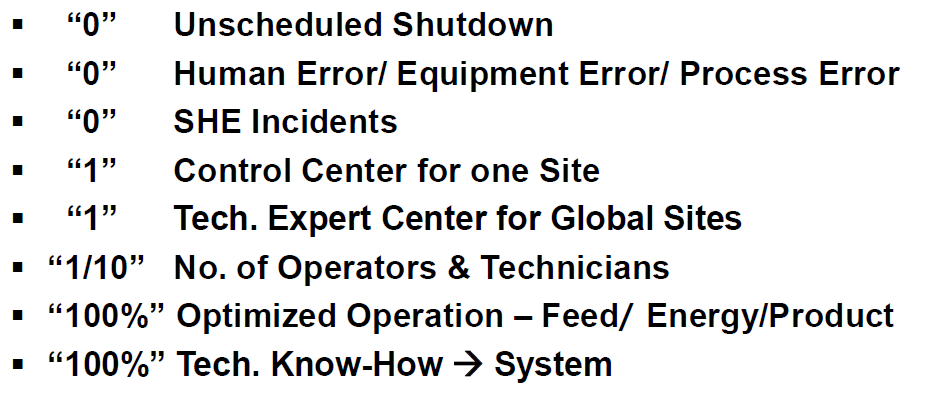
Below is their goals:
Key drive is for zero human, equipment and process shutdowns and errors; this drives towards a significant embedding of process and automation on process and analysis to predict situations so that planned / controlled actions can take place limiting unnecessary shutdowns.

Key is the recognition that number of experts that are going to be available due to new generational work-space is going to be limited, and it is key to dramatically reduce the dependency on these experts by 90%. Another shift is to Global centers of excellence that must have access to timely information in context and trusted to interact with the local teams.

100% optimization of Feed/ Energy/ and Product usually plant have 1 maybe two of these tuned , but not 100% optimized, but this is not as simple as it looks when Feed stocks vary, Products instruction is increasing and Energy is totally variable, but the company has recognized to minimize impact of variability is optimization.   Also the knowledge of the system must be embedded, so the system is intuitive and self aware, enabling operational workers to rotate while maintaining consistency in operations and process.
Intelligent Alarms, and awareness will have to natural, so state / condition pattern analysis the move to the “to be” state is key. Many companies have significant programs in play now for transforming their current alarm structure to enable rapid, intuitive awareness of where that “pin” is in the haystack of alarms, and events.


As the plant becomes more intelligent and able to operate, key decisions and follow through actions in a timely manner are fundamental. This will not be one person; it will be a set of actions, and decisions across a team. So the operational system will be designed with collaboration in mind, the natural ability to guide, have built in operational process, natural documentation of actions, and passing of actions to the next person. Key will be the ability to “Resolve Operational Tasks” through tracking and an operational work system within the system, optimizing the human assets as much as the physical assets and processes.