Showing posts with label Operational Training. Show all posts

Thursday, April 21, 2016

Is the day of User Guides / Manuals coming to end as Learning and Guides Merge???

I constantly work across teams, and companies, and listen now to challenge of the “dynamic workforce” that is rotating on sites and the challenge of “knowledge management/ transfer” constantly raises it’s self.
I was going to do a this weeks blog on a different topic, but a call this morning and one yesterday from engineering partners and customers around “knowledge transfer” and need to reduce the “time to experience” constantly comes up.  So I decided to chat about this challenge.
We have it within product development, how to transfer knowledge to field and set learning just does not work, so “self service” “E Learning is the big thing. But what the engineering house wanted to discuss was about their traditional project documentation, as they feel they waste a lot of time on documents that get out of date, and in many cases are not used.
This is again the same debate we have internally and I read in the forums as the traditional “User Guides” are giving way to videos, and then people debate what is the difference between E Learning, and user guides.
The question was asked why can’t our user question experience be short e learning's, and then if you have someone who wants to end to end learning these short E learning's and structured for a logical flow.
This is certainly where the software market is going, and seems logical for the Solution market. As the solutions developed on stand product need to evolve to solutions, the “learning experience” has to shift to in line, and native.

We have seen out operator training systems accelerate the retention, of data, and process for success. Shift to experiment and hands on, visual experience has an impact. This leads to the discussion of if video, recordings, , embedded simulation cases need to be part of the knowledge system.

Without a doubt “knowledge transfer” in our dynamic world is key, and maintaining the value of knowledge in a form that can easily consumed.
What is required is a knowledge system that:
·       Enables natural access in the context
·       Access remotely on different devices
·       Ability to easily add new knowledge and information.
·       Knowledge Management is key to tune, clean up knowledge, so the system is effective 5/ Rich search ability

The key here is an open system that enables crowd sourcing of information from many different roles, from within the company and from outside, but those who can contribute. The challenge in the industrial world traditionally contribution from roles was limited, this was due to main reasons;
·       The culture and atmosphere have not promoted the sharing, contribution
·       The systems did not enable natural, easy contribution, to one place that enables effective information.

Both of these factors are in transformation:
·       The systems / technologies are now available for knowledge, information systems to common, and easy to use and contribute. A notable example is Wikipedia that has millions of people contributing, and millions using. Key is it is simple to add new and extend knowledge posts from where ever you are. But they have a common hosted system, and they have a team of people reviewing and managing the information, so the system' s value is maintained. But I doubt the “word” is the best mode for rapid intake.

·       The culture of gen y is decidedly different to baby boomer even early gen x, they naturally search, share and contribute. Without this cultural transformation,  the concepts of Wikipedia and Facebook would not have worked, and grown to become such a natural part of the modern lifestyle.

It is time that the concepts of a Wikipedia / Youtube capability become a natural part of the industrial landscape, where the tagging of knowledge can provide the context and linkage with the supervisory system. The supervisory system must naturally call this knowledge system, passing context, and the natural ability to contribute and search.

All operational people no matter device should feel, like they do on Facebook, to add comment, capture events, capture experience from the system, and tag with context to increase search ability and use.
So will we have user guide/ solution manuals or will evolve to online learning, that is adhoc, and evolving vs a “snapshot” in time.

Sunday, December 6, 2015

Accelerated Training is the only way to Deal with Dynamic Workforce Paradigm

As time period workers are in a role and especially a site, the systems and culture of learning, interacting and gaining knowledge must change. This happens with the knowledge and learning coming from this system as the worker requires and prepares for executing a task, vs tradition class / face to face sessions.

Operations teams in a broad range of manufacturing have discovered that the workforce, especially operators, are changing jobs more frequently.  This challenge has become more important than the “aging workforce”, although this also contributes to the acceleration of turnover.  There must be a strategy which effectively trains operators faster than their turnover.

One part of training best practices is to continue the training throughout the operators’ work term, such as summarized in the following diagrams:


The right-hand diagram summarizes some amount of acceleration in benefits, where OTJ is on-the-job training.  While this acceleration appears to be attractive, this acceleration isn’t enough – the time to profitability is still several years.  So an additional strategy is necessary, as shown in the following diagram:


The above diagram describes a strategy of acceleration: instead of focusing on the basics, the training focuses on the dynamic aspects.  This means that the operators are trained as early as possible on “advanced” topics.
The power generation industry has developed a measure of operator excellence called “error free”.  It is a measure where loss of production or damage to equipment was identified with operator errors.  During the last 7 years, power generation companies have demonstrated up to 6:1 acceleration in achieving “error free” status.
The technical change in the training simulators is focused on simulating the dynamic aspects such as weather, supply chain demand and changes in raw materials.

Saturday, September 27, 2014

"Times are a changing": Re imaging of Our World, it is flow on to Industrial Experience

As I sit on a plane heading over the Pacific again, I look around me and even my life and see how we are re imaging, or changing the way we perform daily activities. The different devices, applications change the way in which we engage with traditional activities.

Example below in the images are real:


Hotel checking happens from the applications on my smart phone instead of registering at the front desk.
In Singapore last month it was was Friday afternoon, I was on the street hoping to get a taxi to airport, initially, you think wave one down. No, not today there must have been 8 of us trying to compete for taxis at peek hour. So out comes the smart device and Über application, and I nominated a price on line for car, happy to pay a little bit more to not miss my flight, and secure a service, a win for me, a win for the driver ( he got a bigger fair).

Monday, March 24, 2014

Operations Innovation & Transformation – Training “Systems”

Blog post from Stan DeVries on his thoughts on the Training transformation, operational guidance.
Industrial operations are experiencing innovation and transformation in 2 aspects.  There is a pervasive move to unifying the industrial enterprise over multiple sites with a more holistic view, and there is a pervasive shift to operational teams that spread across the sites, centrally governed, where subject matter experts (SMEs) make use a timely and dynamic decision support system in a dynamic operational world.
Using the recent discussions in the MESA community about the recommendation to consider “behaviors” and “systems” as separate, where “systems” help to achieve, sustain and improve “behaviors”, there has been a revolution in manufacturing and operations Training Systems.  The major change is from a single user, focused on his/her span of control with an isolated context of process or machine control, to multiple users handling multiple processes or machines, and handling more than just speeds and pressures – they contribute to operations performance indicators such as quality and unit costs.  The “contract” between the enterprise and the operator has dramatically changed.  In addition, even the traditional narrow span of control isn’t sufficiently effective when operators have never experienced a full start-up or one of the more severe abnormal situations.

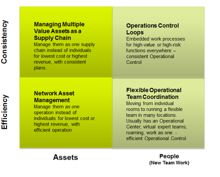
The transformation of the Training Systems and associated innovations is to a group experience training system.  For many operators, there will always be at least one training scenario with a role that is closer to the traditional “fixed span of control” that focuses on a smaller area of operations or set of equipment.  The 4 quadrants are summarized as follows:

An important aspect of training in these 4 quadrants as training for frequent change that is coordinated in teams.  The following diagram shows a “tram line” display.

It is important to note that in most industrial operations, this activity is governed by scheduling or “dispatching” as it is called in the power generation industry.  It is still important for operators to be trained to perform safely and effectively in this dynamic situation.  Using the process control metaphor, this is training for when the Setpoints change dynamically.  The transformation in training for the 4 quadrants is when Setpoints and Measurements change dynamically, in both scheduled and unscheduled situations.
The following are examples of training scenarios for each of the 4 quadrants:
  •        “Fleet” management with a fixed span of control (lower left quadrant).  The trainee learns how to operate their normal area or group of equipment without exceeding quality, operations or safety limits, with dynamic changes in setpoints (setpoints are adjusted by the operator in accordance with instructions).  The flexibility in setpoint position is the key learning experience in this training.
  •        “Fleet” management with adaptive span of control (combination of lower left and lower right quadrants).  The trainee learns how to switch between operating other areas or groups of equipment without exceeding quality, operations or safety limits, with dynamic changes in setpoints (setpoints are adjusted by the operator in accordance with instructions).  The flexibility in span of control is the key learning experience in this training.
  •          “Fleet” management with adaptive span of control and governed changes in targets and limits (combination of lower left, upper right and lower right quadrants).  The trainee learns how to operate as part of a team, where flexibility and agility is increased as the team adapts to exploit opportunities or minimize undesired events.  Typical scenarios include rapid increases and decreases in throughput, but can also include rapid changes in quality (terminology varies in some of the customer industries).  The teamwork is the key learning experience in this training.
  •           “Value chain” management with a fixed span of control (upper left quadrant).  The trainee learns how to adapt to a rapid change in equipment load (reduction indicates a slowdown downstream), where the setpoint instructions haven’t changed but the ability of automatic control to regulate the equipment has changed.  The teamwork is the key learning experience in this training.
  •         “Value chain” management with adaptive span of control (combination of upper left and lower right quadrants).  The trainee learns how to switch between operating other areas or groups of equipment without exceeding quality, operations or safety limits, with dynamic changes in equipment loads (reduction indicates a slowdown downstream), where the setpoint instructions haven’t changed but the ability of automatic control to regulate the equipment has changed.  The teamwork is the key learning experience in this training.
  •          “Value chain” management with adaptive span of control and governed changes in targets and limits (combination of upper left, upper right and lower right quadrants).  The trainee learns how to operate as part of a team, where flexibility and agility is increased as the team adapts to exploit opportunities or minimize undesired events.  Typical scenarios include rapid increases and decreases in throughput, but can also include rapid changes in quality (terminology varies in some of the customer industries).  The teamwork is the key learning experience in this training.

All of the above training scenarios maximize the dependence on sufficient training system fidelity and ideally the fidelity of the training experience.  The training experience includes collaboration and navigation of facilities and operator actions in the “field”.


Saturday, August 11, 2012

Operator Training Systems become the Corner Stone for Management of Change to a Flexible Operational Team.
Over the last month I have hosted a number of customer workshops on the evolution of Operational Teams, which you have seen in the discussion over the last couple of months is going through a significant change.
I enjoy these discussions, and brainstorming, especially with groups who have been charged with Operational Performance, and they have moved away from grinding out more value from capital assets (this is a very mature area with asset management) and have shifted their focus to the Human Assets. It is funny to think 10 years ago we were talking “lights out manufacturing” without humans, the best comment I have heard to this notion is that “turning the lights out makes it hard for operators to find their way to the control room”. The real change is people have realized that complex / agile decisions needed today require the human brain, so the role of people in the aligning of an operational process is key.