Showing posts with label Inflection point of Operational. Show all posts

Sunday, September 27, 2015

The Changing Landscape of Supervisory Systems from HMI, / Common Control Room, to “Distributed Multi Point Operational Landscapes” !!!!!

For the last couple of years we have seen the changing supervisory solutions emerging, that will require a rethink of the underlying systems, and how they implemented and the traditional HMI, Control architectures will not satisfy! Certainly in upstream Oil and Gas, Power, Mining, Water and Smart Cities we have seen a significant growth in the Integrated Operational Center (IOC) concept. Where multiple sites control comes back into one room, where planning and operations can collaborate in real-time. Initially companies just virtualize their existing systems back, and then they standardize the experience for operational alignment and effectiveness, and then they simulation, and model, not many have got to this last step.

But in the last couple of weeks I have sat in discussions where people talk about this central IOC, which is key. When you start peeling back the “day in the life of operations” the IOC is only the “quarterback” in a flexible operational team of different roles, contributing different levels of operational. Combined with dynamic operational landscape, where the operational span of control of operational assets, is dynamically changing all the time. The question is what does the system look like, do the traditional approaches apply?


When you look at the operational landscape below, you can see 100s of operational control points where humans will have to interact with the system, with different spans of control, and operational points will be manned and unmanned on regular basis.


Traditionally companies have used isolated (siloed) HMI, DCS workstation controls at the facilities, and then others at the regional operational centers and then others at the central IOC, and stitched them together. Now you add the dynamic nature of the business with changing assets, and now a mobile workforce we have addition operational stations that of the mobile (roaming worker). All must see the same state, with scope to their span of control, and accountability to control. 
Since the 1990’s, control system technology has enabled a flexible delivery of work, where workers can support both “normal” and “abnormal” situations from multiple locations, either in the same room or across the world.  This mechanism has to be reliable, easy to implement, and easy to maintain.  Some customers have applied this mechanism to more than 5 different “points of operation”, which range from equipment panels, mobile devices and local control rooms to regional and national operations centers.

The requirements have become the following:

  1.        “Transparency of Trusted Operational State”: with real-time operational actionable decisions becoming key, the ability to monitor, the system raise the situation automatically through operational, asset self-awareness. So there is transparency to whole operational landscape situational state.
  2.        “Point of operation”: the implementation must support a configuration where one of the multiple points of operation uniquely can operate, which includes responding to alarms.
  3.        Simultaneous “point of operation”: the implementation must also support a configuration where more than 1 worker can operate, which is rarely more than 2.
  4.        “Span of operation” flexibility: each “point of operation” can be an individual PID, start/stop or device, or it can be a broader “span” of operation.  This “span” must be assignable in a flexible manner, where the “span” can be adjusted to become narrower or broader.  Example conditions include night time or overhaul conditions for some operations.
  5.        Ownership visibility: each possible point of operation must have a simple and clearly visible indication that it doesn’t have ownership, and reinforced indication when it does have the ownership. Clear visibility across the operational landscape as who has point of control, and as a team accountability is understood to respond to the situation promptly.
  6.        Management of alarms: it is essential for safety, legal, environmental and health requirements that new alarms animate, suppress/shelve, annunciate and trigger display changes only at the point(s) of operation, and only the workers using the point(s) of operation can acknowledge or silence new alarms. This means all alarms from asset to process, operational, but scope of alarm responsibility is aligned with span of control, but as a team there are “no blind spots” and alarm, situational awareness is escalated based on responsiveness, and situation. Assumption of control, and someone doing something must be removed.
  7.        Manage of operational events across different points of operation;Example operators want to be able to set operational limits/events across different operations? How is this managed and governed?
  8.         IT/OT seamless integration;Operating, monitoring, trending, alarming and integration with other islands of information to enable the teams to make informed decisions.
  9.         Reliability, upgradable, cyber security, network architecture, cloud;
  10.      One problem cannot bring down the whole operations!!
  11.      Assignment of operation: an authorized worker must have an easy and reliable means to assign and adjust the spans of operation.  The following diagram shows examples of transferring the span of operation between a roving user, a local control room, and a remote operations center:


In the above diagram, Areas or Sites “A” through “D” require supervision by different users or by the same user in different locations.  This scenario also applies to multiple operations consoles or desks within the same room.  The span of operation varies with the operations situations.  The span of operation can overlap among multiple users and multiple locations.

We need one system, but multiple operational points, and layouts, awareness so the OPERATIONAL TEAM can operate in unison, enabling effective operational work. Below is a high-level diagram of the operational team by the situation, you will have multiple skills in each situation, people will move through the situational state, but the diagram shows the merging operational work characteristics.


This emerging dynamic multi-point operational landscape is big topic that I will explore over the next few weeks, as traditional thinking, traditional architectures, and traditional implementations will not enable the transformation in operational work needed to satisfy effective agile operations.


Sunday, June 7, 2015

Can we have the internet of things with operational data management?

We all talk about data from different devices etc. This is well and good but can you really have effective information if the data is not in context?

The challenge is how you gain this context and then sustain this context over many devices (things) without significant impact on the devices, how do add, remove and evolve devices (things). The role of an operational data management system that is a “yellow pages” of the system, providing the context, and relationship between devices and the operations.

Providing the ability to register new devices and associated data, input the associated context, while maintaining the detail in the device, but provide the bigger operational process alignment. This will also provide the association, other naming of that device so other applications, roles can find and interact. Often other systems, machines have a different outlook on the process and will use different naming and referring for the device. The Operational Data Management capability provides this association and ability to align many devices without having change the underlying applications or devices.

From a data to information point of view it provides the contact to gathering of data to shift it to information, so that big data analysis and other tools can be applied transforming that information into “knowledge”. Providing a pattern for contextualized operational data (e.g.: production, quality, machine status, etc.) integrated to templated collaboration activities (ODM) and ultimately broader supply chain management.


Without this companies have a real opportunity of just gathering significant more data without creating or having the ability to create the associated proportion of Information, knowledge and eventually wisdom. The diagram above shows the knowledge management pyramid and how on the right hand side companies have not go the top one which is blow out in data without the associated knowledge. The leaders will put architectures and systems into place which enable them to gain the contextualization while providing the “plug and Play” ability for devices and things to be added to the solution.
Which path are you on, how are you addressing this ODM concept?

Sunday, July 20, 2014

Clear KPIs for Measuring “Smart Plant/ Factory” Success is Key, Again Operations, Humans are Difference in this 4th Industrial Revolution

I seem to have been involved in Smart Fields, Smart Facilities, etc for years, and a lot of the discussion and thought leadership was around information, and more intelligent devices. But many have had limited success, until now, why is because many “smart” strategies did not cover all the bases.

During last week a colleague and I had a number of workshop sessions around forward strategy, reviewing specifically what is different this time round with smart, looking at the “Operational Transformation” event we seeing unfold, what is different and core this time! It was very clear, but so was the significant discontinuity in the market.

When we talk Smart concepts too often, the discussions goes quickly to the “smart/ intelligent” devices, and data and information, with the hype around the “Internet of Things” this continues. But when you really get down to what people are trying to achieve is decisions faster, and flexibility / agility through awareness and operational transparency.  

Yes the real impact here of this Operational Transformation is not just that devices are becoming smarter, “self aware” but the need to gain consistency in operations, and reduce errors. There is significant discontinuity happen in the market, as the logical way to eliminate the errors is through experienced workforce. As we all know that actually the workforce in 5 years will dramatically be less experienced than the workforce of yesterday or today.


The diagram below shows the experienced workforce  today is responsible for most of the unscheduled shutdowns.
So the outlook in the next 5 years is grim as we move to the in experienced workforce, unless our systems and operational processes change that is why “smart xxx” is real.
The major outcomes of the drive towards “smart factories, airports, fields etc” is to embed the operational experience, and self awareness in the Smart Devices” and “Smart Processes” .

Too often we do not have clear goals, but it was interesting to see a leading coming define very clear goals constantly to monitor the direction, and success of this "journey". 

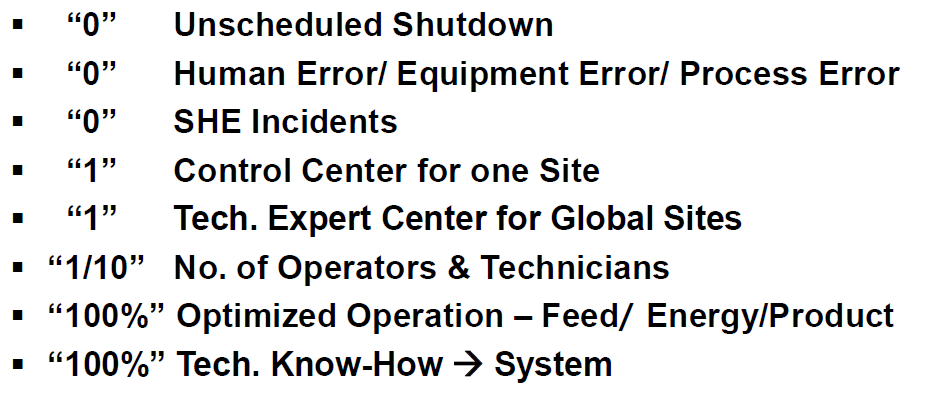
Below is their goals:
Key drive is for zero human, equipment and process shutdowns and errors; this drives towards a significant embedding of process and automation on process and analysis to predict situations so that planned / controlled actions can take place limiting unnecessary shutdowns.

Key is the recognition that number of experts that are going to be available due to new generational work-space is going to be limited, and it is key to dramatically reduce the dependency on these experts by 90%. Another shift is to Global centers of excellence that must have access to timely information in context and trusted to interact with the local teams.

100% optimization of Feed/ Energy/ and Product usually plant have 1 maybe two of these tuned , but not 100% optimized, but this is not as simple as it looks when Feed stocks vary, Products instruction is increasing and Energy is totally variable, but the company has recognized to minimize impact of variability is optimization.   Also the knowledge of the system must be embedded, so the system is intuitive and self aware, enabling operational workers to rotate while maintaining consistency in operations and process.
Intelligent Alarms, and awareness will have to natural, so state / condition pattern analysis the move to the “to be” state is key. Many companies have significant programs in play now for transforming their current alarm structure to enable rapid, intuitive awareness of where that “pin” is in the haystack of alarms, and events.


As the plant becomes more intelligent and able to operate, key decisions and follow through actions in a timely manner are fundamental. This will not be one person; it will be a set of actions, and decisions across a team. So the operational system will be designed with collaboration in mind, the natural ability to guide, have built in operational process, natural documentation of actions, and passing of actions to the next person. Key will be the ability to “Resolve Operational Tasks” through tracking and an operational work system within the system, optimizing the human assets as much as the physical assets and processes.