Showing posts with label Gen Y. Show all posts

Saturday, August 15, 2015

Virtual Expert Teams, Provide One answer to “Time to Performance”

We often hear of the aging workforce as a big problem, and certainly it is due to fact that it is not a evolutionary transition to next generation of workers it is leap to new generation of workers missing at least one generation. So from "baby boomers" to Gen Y or Millennials.

As has been stated many times comes with this a change in "Experience levels" of the job, and site, but correspondingly comes a change in the way they native work, engage with others sharing more, asking more, providing the opportunity to bridge this experience transition.

Last week in some discussions around Integrated Operational Centers (IOC) it was clear that IOC is not about bringing what happens field control rooms into a central location, the real transformation happens when experience and operational work transformation happens. Shifting to an operational experience where:
  • Experience can be shared across sites, and workers through standard operational interfaces and experiences
  • Shift to Exception based experience from monitoring, where the user interacts with the system only when required.
  • Where planners, operational control, and subject matter experts can align, and collaborate in real-time, sharing the same view on a situation.

But it was clear that the companies making the big step are going further, and really introducing the "Flexible Operational Team " concept, shifting from an operator to a true operational team. From site workers who now are agents (eyes) to the rest of the team on site, to central control working closely with real-time planning and work order execution, to experts in maintenance, process, safety, and management providing the real-time knowledge and experience across multiple sites, and multiple situations. The diagram below shows this "flexible operational team" and the associated transformation in operational work across the team, due to new work ethic of sharing and asking.
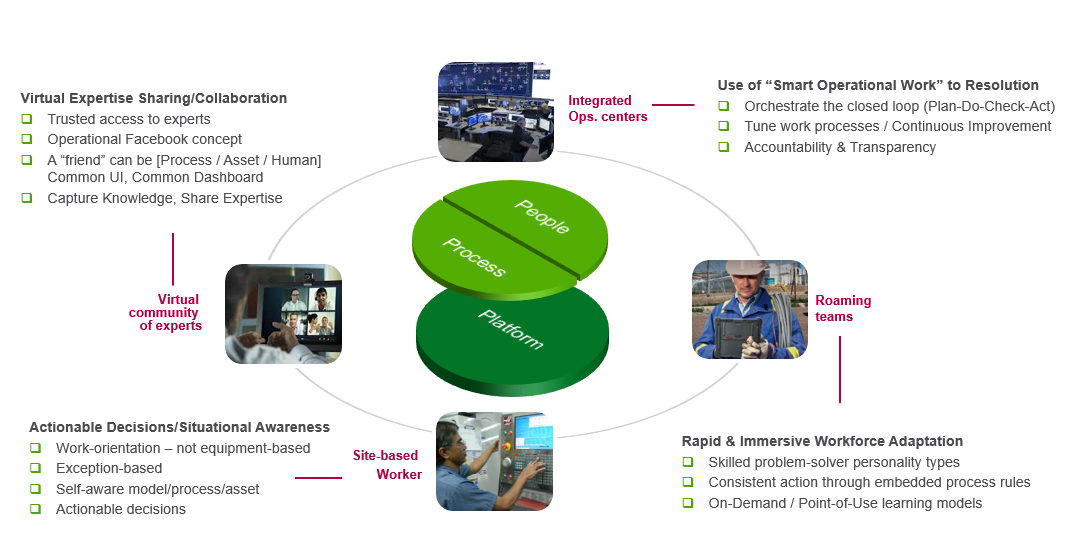


But what we seeing in the market is some innovative approaches to solving this existing experiencing and the transfer, and it is through the use of “Virtual Experts Teams”. So what is this concept?


Key is to have these highly valued knowledge experts which could be across different aspects of the business e.g. asset management, process, planning, optimization, quality being empowered to work across the many enterprise production assets/plants. Today many of these experts are restricted in their contribution to their local plants, but a number of companies have started strategies which say we must leverage these people. These experts must be able to access the state, information of the plants in a consistent manner even though they may have never been there. They must also have the natural ability to collaborate with the local teams.


This means a local team is able to call upon the best experts relative to the situation they are dealing with. The expert is able to go online and access the plant situation in “near real-time” so they can see the situation while collaborating with the site team. They are able to drill in and do analysis, so as to draw upon experience and provide advice in real-time to the local team.

Now is this easy, I would say no, as just accessing the plant data is not effective, as the expert maybe over the other side of the world, never been to the plant and so the data will be in different measures/ context to what he expects. So in order to achieve this virtual team we need to have a “trusted information” system, where the data / information is a consistent context.

But the above concept is real, and is valid with leading companies currently implementing these "virtual communities" with subject matter experts on call across sites and situations. The operational team experience is not a "rip and replace" it is built on the existing automation/ supervisory systems installed in 90s, and 2000s, but now aligned with a validated model, and context. Plus a collaboration user experience where systems notify of "abnormal situations" and the controllers will share and collaborate in real-time, and virtual experts can access their view of the situation in real-time. Note the view of the expert may be different angle on the data relative to their expertise, 

But the system is NOT a one way information system, it is bidirectional, interactive experience with accountability, of action and role, with a built in ability to evolve the knowledge and experience of the system for the future.

Too often I am seeing slices of this Operational Team landscape, being implemented without realizing the whole picture to realize the paradigm shift in value.  


Tuesday, April 7, 2015

Empowering a New Generation of Front Line Workers.

Recruiting and retaining talent is a top concern for management as the global workforce transitions to the “millennial” generation.  Every time I am in front company executives across industries and regions of the world, yes operational efficacy comes up, but always the deep conversation and search for ideas comes around the changing operational workforce, and associated workspace.


The diagram below illustrates the changing workforce:  


While mundane tasks will continue to get more automated, what work remains in terms of executing on the front-lines warrant a smarter workforce to deal with the corresponding rise in process complexity and product velocity of the value chain. Or a Operational System that abstracts this increased and evolving complexity into the system, allowing variability in the workforce experience and skill. In other words, for those on the industrial front-lines, the boundaries between physical vs. information work will continue to erode – which in turn, changes the very nature of the software applications to support these workers.  

The next generation of industrial software must be able to propel the productivity frontier to new limits while accommodating the new expectations of the Millennial workforce. Examples include:       
  • Information at the fingertips: The information they demand to do their job must be equal to or better than their experience as consumers of mobile, social and collaborative technologies.
  • Work to be rewarding: They can accept tough work conditions if it offers them the autonomy to contribute in their own way in order to keep them engaged and committed.
  •  Change jobs more often: As opportunities to grow “up the career ladder” shrink, they will seek lateral mobility for growth, putting greater pressure on software applications to accelerate “time to proficiency” and performance consistency.
As I sit in the Karoo in Southern South Africa, on Easter weekend away with a number of senior managers of companies in different aspects of manufacturing. The conversations do discuss the future of economics, but the big discussion comes back to workforce transformation, skill set development and retention, and new culture and work method with the Gen Y, how to maintain their engagement and interest. In this country (South Africa) where there has been a significant departure of “baby boomer and gen x” over the last 20 years, leaving the current level of Gen Y in the workforce is already at levels of 2020 expectations in western world (40%).

The issue is how to train, retain, and develop skill and experience, so that companies maintain the required output efficiency. The nice part of the discussion is the reality that it is not a transition of workforce, that it is a totally new workforce that will engage, operate and work totally different to the traditional Gen X and before, and the development of an company/ operational culture that is exciting to attract and retain talent is key.

The big question is can this exciting, attractive culture/ experience be created in an economical and sustained way, especially in the current cost restrictive climate? This then leads to a discussion on the alternative discussion around “generalization “ of “activities” through templatisation of processes, and information, so that decisions and actions can be abstracted from the variability in the experience levels of the work force.  The key assumption is worker experience will vary, and your operational practices will evolve and improve with the business at an ever faster rate, the operational systems of 2020 need to enable a workforce of different skill sets to work in a consistent manner making consistent timely decisions and taking proven actions.

The airline industry has done this with pilots being able to move across different plans, meet their operational team ½ hour before flight, and key still act in a timely and consistent manner. Perfect example was the “Hudson River Incident” where the pilots met ½ hour before take-off, and in the 3 minute flight they took actions only speaking once due to repeatable proven procedures to achieve a successful outcome. 

Why cannot we do the same with the industrial landscape and systems, so that we assume that workforce will change, evolve and the operational systems can accommodate this change while maintaining operational efficiency??     

Sunday, March 15, 2015

Multi-site standards have to be economically viable, but Operational Value of standards is the driver vs IT requirement

While flexibility allows us to deal with the plant floor reality, it also comes at a cost and thus requires governance. This is typically where the IT and Engineering perspectives tend to clash:

  1. Standardization (what Corporate IT desires): How to deploy “out-of-the-box” or packaged solutions that reduce risk and time-to-value in implementation across the plant sites? Increasingly Operational value is driving standards and platforms.
  2. Flexibility (what Engineering desires): How to support the various customizations to accommodate the heterogeneous nature of the process within a plant site?

But with the growing demand for agility and ability to absorb new production plans, new product introduction with minimal impact to day to day operations. Combine this the ability to “accommodate variability” in automation systems often from different vendors across multiple plants, or equipment, as well variety in team skills, and experience. The implementation of platforms combined with standards provide the necessary abstraction to “accommodate” this variation. So move to standards is growing driven more from the operational continuity drive than IT (which drove it based upon cost of implementation and sustainability).


To solve the above two seemingly opposable expectations, large enterprise users of a platform use a Center of Excellence approach to centrally manage the template library while helping orchestrate each of the plant’s technology roadmap in a way that is aligned to their Continuous Improvement journey.
The illustration below maps (at a high-level) the governance process of how templates are created, maintained, and modified to support the rollout across a multi-plant standardization effort.

Many of the most successful companies driving standards, are now seeing the rewards and return through agility to absorb new plants into their organization, yet leverage the existing unique automation, plant floor systems.

But so many of them comment to that they learnt the hard way the need for governance, yet site collaboration to make the standards effective and adoption successful. Too many state building standards from the corporate center out seems logical, but in reality so much knowledge is in the field and the need for capturing that experience back into standards is key. Plus the shift with standards away from a project DNA to more of “product” life-cycle DNA is key.

The important learning is that standards are part of a program, they part of learning, but return is significant now not just IT point of view but from an “Operational side” and this is where the significant economical returns are seen through operational consistency, and agility. Understand that standards is a program, clear understand the required governance to succeed long term, and investment up front with the field so the standards will be adopted. Combine this with clear kpis to understand the reason why your implementation a platform and standards so the value can be measured for the long term, as this is a long term initiative that must enable sustainable innovation.

Monday, October 27, 2014

The Perfect Storm in Industrial Operations = New Paradigm in Operational Landscape

I decided to revisit a blog that I have enhanced from over a year as preparation for a discussion I have been having with many people in the last 2 weeks around "realtime Information Platform" vs "Historian" which I enter that discussion in the next blog. Too many people are looking at one aspect.

The most significant disruption in industrial operational strategy is happening in this post GFC (global financial crisis) era.  This is focused on determining an operational execution environment which enables timely contributions by the operational team for sustained high-performance plant execution.  The focus is currently on operational processes, but this will shift quickly to driving a new operational experience which enables a new operational execution plan. Traditional user interfaces will not “cut it” both in products, or the way they have been implemented.

A common thread around the world is the operational personnel challenge, especially the finding of people to replace the existing “baby boomer generation” and lack of experience available in the market.
This is only part of the most significant disruption in operational strategy in the last 20 years, even since the introduction of the PC.  There is a perfect storm happening, with these vectors:
  •        Ageing workforce: the significant number of highly experienced operations, maintenance, process workers who will retire in the next 5 to 10 years.  Some mangers in “oil and gas upstream” talk about the fact that 80% of their current team will be gone in 5 years.
  •          Operational Agility means Decision NOW: to be competitive, decisions must be made now, this has caused a change in thinking that workers need to be empowered to make more decisions, through more information, higher knowledge and access to experience, and a transition from “worker” to “knowledge worker”.  This also means that they have much more responsibility.  As one customer recently stated, traditionally they had an operator cover 5 to 10 wells; this was fine when you have 100 wells which lasted 20 years, but in the next 5 years he stated “we will have 20,000 + wells, but we will not have 2,000 operators”.
  •          The rotating operational person means “time to experience” is shorter than ever: the experienced generation is retiring and transitioning to an age group 20 years their junior, and there is a new factor that people are not staying in their role or location longer than a year.  One company stated 10 years ago that people were in a role approximately 5 years, but now they are seeing rotations of 8 months.
  •         Transition to digital native worker, with very different expectations, causes challenges with worker retention: The new generation is “digitally native”; they expect access to knowledge, they expect “touch experience”, they expect collaboration from anywhere, and they expect to learn on the fly.

Stepping back and looking at all of these vectors; we have significant disruptions for those in charge of industrial / manufacturing operational execution strategies.
Addressing that significant disruption will require a combination of techniques:
  •          A new generation of user interface products with more than interface capability, but embedded knowledge access, experience access, actionable procedures and natural intelligence, really empower the operational workers in all roles.
  •          A new operational experience design.  Notice that the traditional enabler -HMI (Human Machine Interface) does not express this new design: as it is a true “operational experience” that goes through the “day in the life” of the new generation of operational knowledge workers.
  •          New alignment across the different systems, plant applications and sites to align context, actions. Keeping the sites, applications and systems “loosely coupled but tightly aligned”.

Why?  Because today is not about Control Rooms; it is about agility and timely decisions, and this requires the “Flexible Operational Team” that works naturally together to leverage their experience, in the NOW to have decisions of all sorts made in a timely manner (often earlier than “now” to prevent instead of react).


The above diagram shows the concept of Flexible Operational Team, where at the bottom the traditional User Interfaces (UI’s) would have been permanently manned.  These UI’s are becoming transiently manned, but all functions relative to the zone of responsibility are available.  The more central operational centers (increasingly remote) will have a “quarterback” operational controller who is calling the shots, with a transient in-plant team of different skill sets, and a virtual team of experts usually external to the plant.  The in plant team executes activities that must be done locally, e.g. Inspections, maintenance, and certain manual operations, and the virtual team are experts across the world who can be tapped on for experience and knowledge to work with the controller or the in-plant team.
The above requirements is driving customers to look at the concept of “Enterprise Control”, providing the unification, and evolution of existing systems to achieve the alignment required to enable the concept of “agility thru Operational alignment and decisions in the NOW”.
The Invensys Enterprise Control Vision is to provide a set of capabilities that enables customers to achieve "Operational Excellence” through three strategies:
  •          Empowerment of Operational People

Operational personnel (e.g. Operators, process engineers, process experts, maintenance, quality, production management) are empowered real-time decisions through operational awareness, access to experience, collaboration, and best practices in a proactive system, to perform multiple tasks, in flexible roles, in multiple locations.
  •          Unification through Federation across assets, applications and systems

Align the different assets and processes across the operational management layer (of the traditional automation levels) so that the industrial operations are more agile (can change equipment configuration and use of the equipment much faster and much tighter coordination).  These assets that reside within a plant, within a process and across multiple sites are aligned to business and operational processes and require consistent measures and information.  Each of the existing applications/ controls continue to run, but their information and visualisation models are aligned, and communication happens with orchestration execution, in order for the Operational Process to execute in the most timely and effective manner.
  •          Built on a Sustainable platform of capability so that the system has longevity to evolve.

Enterprise Control will be implemented in stages and evolve in scope, breadth and functionality through its lifetime at each customer installation, which could be 20 years.  The system has been engineered and architected in a way that enables this evolution to occur in a sustainable way and caters to changing engineering teams and technologies.

New technology products will enable the above operational/automation paradigms, satisfying the changes in the market and workforce, compelling all of us to think and engineer differently as we evolve our operational systems.
I am hoping this refresh and discussion answers many of the questions people have asked me lately, as it is not just about the ageing workforce, the transition, the whole workforce culture and approach to work will be different in 5 to 10 years, and it really is a transformation to "smart work" in the industrial operational space. 

Sunday, October 19, 2014

The Paradox of the Growing Trend of Increasing Complexity in Industrial/Operational Solutions

I was discussing with a customer this week their systems, solutions, what was being asked of his team, and how even on a medium sized business and mature production processes the solution complexity is growing. He talked about the continued pressure of audits, regulations to satisfy government and just the consumer, combined with an increasing rate of " new product introduction" (npi). Yet production agility, timely actionable decisions, demands real time transparency into production, and across the supply chain.

Over two pots of tea we mapped out a high level functional landscape, his comment what happened to traditional  solutions. His comment was valid as the traditional supervisory solutions of 10 years ago, had transformed on the paper in front of us to "operational management architecture". With now an architectural landscape that connects to:

1.       Multiple vendor controllers and smart devices from ever increasing intelligent process equipment
2.       The range of people with different roles is increasing, in this example we have 8 different roles interacting with the solution, and taking actionable decisions
3.       The location of these people has shifted from the control room to every where, eg in the control room, roaming the plant floor, roaming the office, working remote outside the plant.
4.       Multiple applications that the system interacts with, has gone from to 7 This is not a big system, yes it is a batch system, but now cyber security, data transformation to deliver the correct trusted information for a role is available.

So complexity is increasing but the outlook is this will not change that business  will continue to demand more interactive, real times, collaborative, and transparent solutions in order to maintain competitiveness.

As seen below from an interview in North America, note the % of skilled and highly skilled roles, and the future additions of roles is in this skilled and highly skilled area:

So the complexity grows at a time when we have a transition to a less experience workforce, that will be in constant state of learning, and dynamic nature. In the conversation we talked about the team on his site, that he now had 50+ experienced and a junior engineer in his 20s. Fully capable but different, and less experienced on a site and role.

The diagram below shows the same people when trying to fill these skilled and highly skilled roles.

This is the paradox of today's dilemma facing engineers and operations, combine this with the demand projects with shorter project time, and that the system will evolve.

Now the control on the prices systems has not dramatically increased this is well defined and mature, it is the ability to absorb change that is key.

As we concluded our second pot of tea, it was clear the need to shift away from customer, home built solutions, away from customer excel sheets, to "off the shelf" solutions products that interact, can be easily configured and provide intuitive use, and learning, on an architecture that absorbs evolution and change. The discussion shifted to how transform their internal resources from internal customer code creation, to configuration, and acceleration of a more expansive solution building on their skill and knowledge.

The key walk away from this conversation, and why I shared it, was the realization by the customer that his approach to projects, and direction of addressing demands from operations needed a rethink in their approach, and using of existing staff, especially with the key experienced staff, and development of new staff. This included looking outside their own industry to potential significant advancements in addressing common operational approaches. 


Tuesday, August 19, 2014

Knowledge must transfer to Industrial Systems to Combat the Skill Shortage/ Lack of Experts

A couple of weeks ago I talked about tacit knowledge and how it is key due changing way experts will be deployed, and short fall in skilled workforce. This was driven home again this week, with the release of skill assessment by “Accenture 2014 Manufacturing Skills and Training Study” that showed some real truths to the situation in the USA.
The diagram below show the current split of jobs that Highly skilled to skilled to unskilled, then the second shows that percentage of the Highly skilled and skilled jobs will grow over the next 2 years.

This is in total contradiction to the next set of questions around how severe is the skill shortage in customers.
The take away is that we putting in more complex processes, and systems in order to compete in the “flat world” which requires increased skilled people, yet there is reducing capacity in skilled, and highly skilled talent, actually the pool is shrinking.
The study goes on to talk about training and the use of operator training systems, and the need for intuitive (self learning) systems. But my thoughts rang back to discussion on Tacit Knowledge and how critical it is to capture experience not in words, or videos, but in systems that enable actionable decisions (built on embedded captured operational experience). Examples are Embedded operational Procedures, simulation for the future, pattern recognition on conditions to see events before they happen, all new techniques just entering the operational systems.  
Tacit knowledge is not easily shared. Although it is that which is used by all people, it is not necessarily able to be easily articulated. It consists of beliefs, ideals, values, schemata and mental models which are deeply ingrained in us and which we often take for granted. The key to acquiring tacit knowledge is experience. Without some form of shared experience, it is extremely difficult for people to share each other's thinking processes.
Tacit knowledge has been described as “know-how” – as opposed to “know-what” (facts), “know-why” (science), or “know-who” (networking). It involves learning and skill but not in a way that can be written down. On this account knowing-how or embodied knowledge is characteristic of the expert, who acts, makes judgments, and so forth without explicitly reflecting on the principles or rules involved. The expert works without having a theory of his or her work; he or she just performs skillfully without deliberation or focused attention. Apprentices, for example, work with their mentors and learn craftsmanship not through language but by observation, imitation, and practice.

The study goes on to provide examples of the impact of this shortage for a midsized $500m complaint to be $4.6m loss annually:
Food for thought!!! Tacit Knowledge must be captured in a form that new users can take actionable decisions in a reliable and effective way, through knowledge and experience moving from the experts to the systems in a sustainable approach that can evolve.

Monday, July 7, 2014

Smart Plant a Realistic / Holistic View

Smart Cities, Smart Airports, Smart Farms, Smart Upstream Fields are all the talk, but when you get down to interviews with companies, cities etc, the definitions change from city to city, from major oil company to another, so if you looking for a clean definition it not to be found. But there are underlying trends you see across all of them:
Trends/ Objectives:
·         Faster decisions and less people monitoring / responsible for more. Leading to the Integrated Operational (control) centers.
·         Increased agility and efficiency through transparency across the whole landscape, so better alignment to plans
·         Increased Operational Continuity
·         Lowering of cost through increased understanding of operations, and operational efficiency of assets. Energy management and material management.
·         The Operational Workforce transition of experience and to a dynamic, digital workforce.
·         Environmental/ Safety and regulation control, limiting exposure and cost
·         Change of equipment/ instruments to “smart equipment” which have increased intelligence and “self monitoring” , a dramatic increase in data that needs to be understood, and used for more predictive awareness
Yes this is all a part of the Operational Transition I have been talking about, and believe will transform the industrial sector over the next 5 to 10 years, as part of the 3rd industrial revolution.
But in the last couple of weeks we have worked with a company in Asia who has a really good grasp of “smart plant” and the overall concepts that need to addressed in their journey.

They are really looking at the 4 main themes with their unique names, but they also looking across these and how they interact, as well not just a plant but across assets.
This is built on their belief that Operational Workspace is changing and not in one area but multiple dimensions, with workforce change, but also ICT changes like “cloud," “Bandwidth," IOT (Internet of Things), Smart / intelligent devices, and the move to naturally using simulation.
The diagram below shows the two big axis they see changing, not too different to People and Asset changes we have seen before.
An interesting observation is the shift to “larger, more complex process” this is true in all industries, as the problem we are being asked to solve is significant compared with the traditional control, but the opportunity for return is significant as well. But with the use of centralized computing, and shared learning, the cost, and ability to solve these today over all size plants is possible.
In reality the fact that this company has engaged on journey and understands it is journey is important, understands the goals, and direction, the shift to manage “work” and transition their architecture to embrace “intelligent devices” so they can leverage the IoT developments and Big Data, Industrial Analytics. Probably means they will lead the transition and be positioned well in the new world beyond 2020, but we all entering this world!     


Monday, December 16, 2013

Review of the Blog “A Look at Industrial Operational Management Environment in 2020!!”


Throughout 2013, this blog and the message it brings has generated a lot of discussions and thought, debate when it comes to technology, architectural and cultural decisions being made around industrial solutions. The traditional approach we have taken for the last 20 years in design even evolutionary design of solutions must change, as there are too many vectors arriving at single point in time around:

·         Culture

·         Operational Agility to enable survival

·         Digital native workers

·         Safety and environmental impact

·         Combined with operational practices transformation

·         Technology like the “Cloud” and “Internet of things” extending the scope of the traditional industrial solutions to a wider value chain

I have been asked a number of times what were the big changes in 2013, basically they are listed above. Really when you look at these in the context of “the industrial landscape in 2020”, the transformation and decisions in architectures are key. As stated last week the “internet” will be part of the backbone of the industrial solutions; we will have “on premise “ and “off premise” components of this solution, and the shift to “activities” that transverse devices, roles, and locations are a key turn in the design approach.

So as you wind down on the year and wind up for Xmas I thought it was a good thing to reflect on what I started with this year, the projected landscape in 2020 and the only change is that, in some parts of the world such as China, South Africa many of the characteristics apply today.

Lets face it 2020 is only 8 years away, look at 8 years ago: Facebook had barely launched; iPhone and iPad did not exist, the A380 Airbus had not flown, and there was no YouTube, Twitter had not taken. Yet today Facebook, Youtube and social media are a natural part of our culture and lifestyle. I phone has now past MS Outlook as the world's largest email client, and mobile devices outsell all PC sales, which shows the significant shift in everyday life to always connected with the mobile device, not just for calls, but a text, news, email. Imagine doing business today without a mobile being able to access the required information. So in 2020, what will be a natural part of the Industrial Operational Management/ Plant Operations “day in the life”.

Are we designing today's systems for the future, are we looking at work ethic of 5 to 8 years out when designing? The answer is probably not farther than 2 to 3 years this could be a mistake when all the factors are changing so much.

Over the holiday period in my reading,  I ran into an article “How we’ll do Business in 2012” by futurist Morris Miselowski, which provoked reflection on much of what this blog covered last year, and thoughts about reality at that point in time. During my last trip to UK, I visited a client whom I thought is coming to grip with their automation/ operation system design and planning, but looking into the period 2015 to 20, and defining the roles but most of all the “day in the life” of those roles in 2018/20. This is the correct way to go as it allows the thought and design pattern to shift to the new paradigm we will be facing in 2020.

So let’s set some facts down about the state of the world in 2020 from Mike Miselowski’s article:

  • The 32nd Olympic Games will be held.
  • It will be a leap year.
  • Baby Boomers will be older than 60
  • One in five of us will be over 60 years of age.
  • One in three employees will be working casual, part-time or project base vs career in a company.
  • 40% of today’s senior leaders will have reached retirement age.
  • Gen Y will account for 42% of the workforce.
  • The average tenure in a jib / role will be 2.4 years
  • One in four workers will be working remotely and virtually.

The last 5 points echo a lot of what we are starting to see in the market, especially in certain parts of the world e.g.| China and South Africa have both lost the Baby Boomer and the first half of Gen X generations. Gen Y is already a significant portion in their workforce, bringing with them real-time/ transient approaches to tasks with limited experience, they require solutions to absorb this work ethic vs challenge it. By 2020, we will all be in this mode, and it is the thought / and industry leaders who “embrace” this transitional work ethic so they can execute and grow the business by harnessing it that will be a leapfrogging the market.

Mike Miselowski made a comment on tomorrow’s workplace in business, but it applies to the operational space as well:

“The 2020 workplace will need to be adept at uniting a physically – present tribe of employees with a tribe of offsite, and often transient, staff. The latter will be specifically chosen for their ability to add value to the task or project, regardless of where they are on the globe.”

This concept aligns with the thoughts we have discussed in this blog around the transition from Applications – to – Roles – to – Activities, in the operational life. Many businesses are going away from offices to activity based workplaces where you choose you workplace (desk), location for the day based on the most efficient place to execute activities at hand. Compare this with the traditional office with family photos, and all your files. Now the workspace is clear with a power supply, internet connection (probably wireless) and all your files and information will be in the “cloud” or only local working space on your local device. Traditional automation solutions run a process with a specific layout for a PC or workstation which does not align with “activity” thinking, agility in users/ roles, the industrial operational work experience of tomorrow must allow activities to be chosen and the materials, information and procedures to execute all available no matter my location or device.

Tomorrow the “cloud” will be a natural part of the operational, automation world especially relative to information sharing, knowledge management, operational procedures consistently, and KPI consistently. The architectural landscape will be an “Industrial Enterprise landscape” across the value chain of the product, spanning plants, countries, cultures, automation systems, and vendors and companies. Yes,  the “federated” operational system delivering the product / service required to be “end to end” to the customer, with real-time awareness, and agility across the value chain, and this will span companies. The only way to compete is based upon service, requiring  responsiveness and agility.   

The average tenure will be 2.4 years, and if you consider 6 months to a year in today's terms is used in bringing a new person into the role to 100 % productivity. The approach to “time to performance” of new personal will need to change dramatically, and learning will natural, on the job, and self/ online training. Manuals will only be references, the learning and understanding will be You Tubes for short, focused skill absorption. The attitude of “why not”, and “what if” will prevail, and the system must explain or limit the “why not” and enable the “what if” question to be answered.

Systems will constantly evolving and changing, as changes in the “value chain of a product or service” evolve with different players, plants, supplies the ability to “plug and play” a new member of the value chain into flowing system will be key.
All the best for Xmas and New Year, and as you reflect on the year ahead I hope some of the comments above are forming some of the foundation for the themes for 2014, it will be a very exciting year, as the reality in the transformation of the industrial landscape takes shape initially from vendor offerings (Example this time last year the historians were “on premise” now two leading vendors have solutions for Tier2 (enterprise Historians) in the cloud) Invensys been one.

Saturday, October 12, 2013

Operational Transformation of Supervisory and Operational Landscape will Take Center Stage!!


As I sit waiting in another airline lounge ready to cross the Pacific again, my thoughts go to the key message that was delivered in Europe User Group Events 2 weeks ago, the event in Brisbane last Friday for the launch of Foxobro Evo(new Systems offering from Foxobro), and then in this weeks North American User Conference in Dallas.

The consistent message from customers to discuss, is “how do we deal with the changing operational culture”? I will be delivering 3 sessions on the operational transformation that is happening in the industrial world:

  • Supervisory Transformation from HMIs to an Operational Landscape
  • Information transformation from historians to Operation Information
  • Operational Transformation from MES to Operational Management across sites

None of this is new, but the diagram below reflects the transformation at the supervisory level, where:

  • Existing HMIs from 90s designed for the “island” process and the Gen X thinking are needing to reviewed, people are needing upgrade the technology, but with that transform.
  • There is the transformation of the workforce to “digital native”, to shorter tenure ships in roles and locations, to multitasking as a natural work method.
  • Operational practice transformation driven by competing in the “flat world” where decisions need to be now, inventory levels are minimum, product change is norm, new product introduction is rapid and across the world. Regulatory constraints impact and we from working on our own to working in teams, leveraging different roles, skills to make decisions and take actions faster and in more consistent way.
  • Accountability and governance is growing
  • Scope of management is growing, and the day in the life is changing, not behind one desk.


Why would you just upgrade to the latest version, when you probably have different HMIs from different vendors and version, done by different project teams all working in isolation limited interaction.

The move to modern operational experience system,  adopting the hierarchy, and object strategies for standards, embedding operational process, building in natural governance and intuition. Collaboration is natural including sharing, and the ability for the teams to virtual, so expertise is at the “finger tip”.

It is necessary to note that this is not just a vendor evolution, to me it is more and solution and cultural evolution and realization, where are you in this journey???
The reaction and discussion will be good, one of the areas we engaging in a series of sessions around operational world , roles, devices, “day in the life” in 2018-20.  The fact that the demand for these one on one sessions has been astounding is indicative of the change and awareness!! 

Sunday, September 29, 2013

Is the Transition to Gen Y so Significant in the Industrial Environment?


This question was put to me by a magazine editor in Czech Republic this week, he was from Gen Y (born after 1980), and he was commenting after one of my presentations.  This is not the first time I have asked “do you genuinely think the transition to Gen Y will be that significant?” It is truly valid challenge, so I decided I needed answer why I believe it is a significant milestone or transition in the operational approach or culture in the Industrial Market.

As he asked the question he was texting and recording the interview on a Samsung PDA, and he had prepared his questions well, by researching me on Linkedln, and reading this blog. To him this was a natural way of doing research, yet an interviewer the week before from Gen X (early) had not done this research, he just had heard my presentation and asked questions based off this.

Yes, many of us from the  Bayboomer, Gen X generations have transitioned to living by our PDA, always “connected” and using email and text for communication, we do our research off Youtubes and forums, but while we transitioned it is not natural. We certainly do not share as well, yes some of us have Facebook accounts, but many do not. I asked a group of 120 people in the Gen X and Babyboomer generations how many had Facebook accounts it was less than 20%, but the small segment who were Gen Y had 100% with FaceBook accounts and all had contributed at least 1 you tube to public domain.

Gen Y has grown up in an environment where the internet is just a natural part of life, most would not remember a time without internet, and the same applied to mobiles that are used for more than voice. SMS texting comes before having an email account, where to Gen X we had email before Text, and tend to use email as the primary text communication vs SMS. The way Gen Y naturally searches on Google and filters the information and rapidly transverse the information to a desired result. They expect to use a map on PDA and see the closest banks, restaurants and other information. Wiki Pedia is a natural source of knowledge, and it is natural to contribute with comments, and material to Youtube and pedia style environments. The most significant transition of generation from Early Gen X and Babyboomer is the shorter time in a role and location, the willingness to transition their career more often. Remembering by 2020 the expectation is the average tenure in a role will be 2.4 years or fewer, people are expected to have at least 4 careers and over 20 jobs in these careers.

These are contributors to the transition, but given that many of the industrial supervisory and operational interfaces/ experiences created over the last 15 years, have been defined to control the process of a unit or equipment. Many are in isolation (islands of control) with limited inter application integration as the design was not done in a holistic view as the project had a deliverable goal and timeline. The navigation, and operations/ actions of the user interface had a fixed button navigation, and assumed a certain level of experience, and on how to use interface and control the process, this experience often came from training on the interface by the developer to the users.

Combining the holistic end to end operational control which requires multiple workers to run the system, often the operational stations are now transitional, so the workers will transition from one workstation to another executing the actions, the experience needs to be consistent to help smooth transition as they do their daily role, plus the ability to access the states elsewhere in the plant, based upon a notification they would have received maybe on a screen or mobile, and they require more detail than available on mobile, so they will drill in using a remote workstation. Now as the worker is executing his day, he is faced with a situation that is new to him, or requires some process experience, and he is unsure of the decision to take as he has only been in this plant 3 months. The operational interface requires for the user to collaborate with a remote expert on that process, sharing the situation, some screens and states, plus a live conversation, this should be natural in order to make a decision and take a correct action as soon as possible.

So when I talk about the significant evolution we going through in operational culture and approach, I am referring to the ability to maintain operational continuity while absorbing this constantly dynamic / rotating operational workforce with now limited experience in a role and location.

The growth in operational programs that are looking re-engineering their supervisory (HMI) systems, and operational interfaces to provide:

  • Consistency of operational experience across workstations and devices
  • Natural Collaboration with others of more experience or in the operational team.
  • Multi workstation and mobile devices on a common system that interact
  • The natural learning, and knowledge management and access
  • Consistency in operational actions across workstations, devices and processes
  • The shift to exception based operational control, using the ASM (abnormal Situation Management concepts) for faster recognition and action on the situation.

Is confirmation that it is not a technology upgrade only it is an operational culture approach that is driving the expectation significant increase operational agility?

Is your supervisory/ plant operational system ready to absorb a dynamic workforce, while maintain operational continuity in the agile world of increased new product introduction, and competitive pressures.

I would be interested in people’s comments.

Sunday, August 18, 2013

Key Operational Challengers of the next 10 years: New Product Introduction, Agility to Change, and Operational Effectiveness with a transforming workforce.


Sitting at dinner with three end users who own strategy, we had a stimulating discussion on the key design parameters or drivers for operational/ automation systems over the next 10 years. Key was the high level operational drivers not the technical hurdles that they are facing as these are just constraints that designs and new practices must absorb. One End users from Water utilities industry, food manufacturing, other from mining. The surprising part was that within 15 minutes we had narrowed the drivers to three key items:

Agility to adjust to market conditions and change:

The clear common requirement was the end to end operational alignment, understanding across the value chain. This holistic operational control, was a significant change in all three industries the sites had run with independence, in all cases the expectation was that site / regional uniqueness will be maintained but now alignment and traceability of action, product across the total value chain, e.g.| multiple assets/sites. A fascinating discussion here was both water and food talked that they expect this end to end to include outsourced assets that make up the chain, and effect the quality of the product or service that their brand is delivering. This is why it is the ability to federate assets and systems while still allowing site uniqueness is key. The inclusion of non company assets in the value chain and requiring operational traceability, accountability and agility to change are just around the corner.
 
The operational workforce transformation operational role retention / rotation: The impact of the operational culture, approach with gen Y and more holistic operations. These  have covered extensively in the blogs, but is the area both of my dinner companions spent over 50% of dinner time. The key areas are

·       The knowledge transfer from the retiring generation and how is the captured.

·      The highest critical concern is the fact they are already seeing people in roles for much less time, and this is across the operational roles. So the issue is how to embedded and design the experiences to enable to become effective dramatically faster, e.g.| 20% of the time today. Our conversation went away from industrial operational systems, to commercial systems, such as Facebook, banks, mobile phone applications. The key here is these applications are being delivered to market without having to train the users, they have intuitive experience that leads users through the steps. Agreement that this is a paradigm shift in operational design, from today's approach where user interface is thought of well after the control, and we have engineers who are not human in factor people, designing the systems. All attendees said we need to continue this discussion, as this is not just control rooms, but reports, and information etc. 

New Product Introduction: The life time of products and services is dramatically reducing, and the companies stated that seem to have ever change and introduction of new products and services. The move is to individual products and services for each consumer. How do we introduce, absorb these new products and services to the operational systems that will deliver them in a timely manner without significant error.

This could be considered agility, but both wanted this pointed out separately as it is a real dynamic that effecting them, vs the infrastructure and assets that are also changing and must absorb agility of change. An intriguing point here was that they commented that operational system and automation system absorb new product introductions without change, but all commented on the challenge of new assets with existing systems requiring federation into the system, and how do introduce new products procedures to operational staff. So the discussion for new product introduction was not just for systems, but also for people to execute, how can they take the new product from the PLM system, and deliver the control, and instructions, across many sites with different systems, and different cultures.  

Are these three points new no, but the fact that 3 decidedly different thought leaders from three different industries rapidly agreed on these as operational drivers, combining this with the fact that each point effects the others. The eventual take away was they were being asked to deliver one operational ecosystem to run the end to end product production over multiple assets with operational consistency. While 3 dynamics constantly change, the value assets / plants are added and taken away, new products and services are added at an ever increasing rate, while the operational workforce is becoming dynamic with a culture of evolution of the role and job, and people will not be in a role longer than 2 years.

What and exciting time we live in!!!

Saturday, April 13, 2013

Work as we may not know it “Comments on the Future of Work and Employment “


Last week I was in California a number of people commented on my blog in January on 2020, and landscape, and I had to explain points. Is it the    future I believe it is becoming real in many parts of the world today especially the likes of China and South Africa where educated Gen X and Baby Boomers are in shortage, so Gen Y is stepping up into more prominent roles in the workforce. On the way across on the plane I was reviewing Morris Miselowski’s blogs, his specialty is future –vision since 1981. He had a good blog which would expand on many of these workforce

This is an extract from this Morris Miselowski’s Future of Work and Employment

“The good news is that there will be employment way into the future, there has to be. Things will always need to be done, built, sold, fixed, transported and accounted for and always will.

The other wonderful, or perhaps disconcerting news, depending on whether you’re a half full or half empty kind of person, is that we’re not going to need furriers, blacksmiths or elevator operators much anymore.

Now I know that’s kind of obvious, but these professions were great honorable and inspiring jobs in their day, using cutting edge technology and machinery to fulfill a society’s dreams and demands.

Tomorrow’s employment space, made up of a dwindling baby boomer cohort and increasing X,Y,Z and A generations will have 6 careers and 14 jobs. They will work towards the completion of tasks and project, not time allocation; in industries we cannot yet name, nor fathom, using skills that today are unimaginable.

By 2025, 60% of us will be working digitally and remotely, not tethered to a fixed workspace, but rather in a time and place that best suits the work and the people involved.

Some of us will work as intraprenuers, inspiring our host company’s internally. Others will work as solopreneurs shaping their own destiny and pioneering new paths forward.

Many of us will be working collaboratively co-creating locally, nationally and globally in virtual tribes, connected by a trillion digital things that bestow on us constant contact with, insight to and manipulation of, our physical and digital worlds.

Global unemployment will remain high as over the next three decades we add two billion people to our planet.

Despite this it will remain difficult for employers to find talented employees, as we move through a tectonic shift of inventing and reskilling ourselves to reshape and repurpose existing businesses and professions, as well as forging new horizon industries, practices, business paradigms, ethics and professions.

Education and training will remain a constant to grease this transformation of knowledge, the internet will continue to help to spread this information, but with the overwhelming mountains of data we’re drowning in, businesses and individuals will soon value “wisdom” more highly than gold and oil and professions and industry’s will rise to mine these riches.

Our most prized vocational possession will be our ability to span the duality of working simultaneously in a physical and digital world.

Tomorrow’s work landscape will also see the increasing use of robots, virtualization, telecommuting and 3D printing further blurring the intersection of human and machine and igniting the question of whether human or machine is best-fit for the task at hand and does it matter?

Standing still is no longer a viable option.

Every job, every profession, every human activity is currently being redefined. Those that are destined to succeed are now standing firm-footed on the precipice of change eagerly scanning their horizon searching for tomorrow’s possibilities and necessities.”
Food for thought as we look at the “Industrial Operations “ evolution that is happening, the debate that it could be a revolution, as the time span is much shorted than the traditional transitions in the industrial market.