Industry 4.0 is a relevant and significant shift in how
industrial automation and operations management software is implemented and
used to deliver significant business improvements. However, it is too simplistic to directly apply
the Industry 4.0 concepts to all manufacturing industries, or without
considering industrial requirements which are not addressed by this
activity. The following is a set of
viewpoints which are discussed in this white paper:
- Industry 4.0 is about the transformation from controlling focusing on process to “controlling the product/ order” and the “product/ order being self aware”.
- Industry 4.0 is about operations transformation, not about technology.
- Industry 4.0 provides a practical strategic framework for “lean” and “agile” industrial operations.
- Industry 4.0 addresses the needs of discrete and batch manufacturing, but it needs some adaptation for the heavy process and infrastructure industries.
Cloud computing and IT/OT convergence are often linked to
implementing Industry 4.0, but these needs some adaptation to address
“trustworthiness” of the architectures.
One emerging topic is Fog computing.
The functions and requirements of automation and operation
management technology are even more relevant than before (contrary to some of
the recent vendor claims).
Information standards such as IEC 61850/ISO9506, ISA-95/ISO62264,
PRODML etc. are even more relevant than before .
Industry 4.0 is about the transformation from controlling focusing on
process to “controlling the product/ order” and the “product/ order being
self-aware”
Industry
solutions and products have traditionally been focused on controlling the
“process” in order to deliver the product.
But as the agility in the market changes, “new product introductions”
and increasing, product lifetimes are shortening and becoming for
individualized even to a point per order or customer. This is driving the operational world towards
“controlling the product/ Order” vs the process as the process will naturally
be controlled if the equipment, process is set up for the order. This requires the “order” to be “self-aware”
of its required characteristics to satisfy the order/ customer. So that it can make the system is set up/ and
process runs according to the order. Driving “first run” success, and that the
product/ order will create warnings, alarms, and enforce required actions to
maintain it road to success.
Even in heavy
process industries such as oil and gas, the requirement to develop more
individualized products/ orders is key.
Scheduling is becoming a part of everyone’s role relative to their time
slice/ span of awareness.
So the
ability to track an order through the process, read and understand current
condition of the product/ order, simulate the characteristics of the order, now
and into the future based on the current condition and environment of the
process, and equipment is a corner stone.
Industry 4.0 is about operations transformation
One of the central thoughts of this activity is transforming
how work gets done. Transformation of
work often includes combinations of the following:
- When work gets done – proactive decision-making before desired changes and undesired conditions occur. This is very different than “reacting better”. This isn’t about “real time” work – it’s about “right time” work, which means early enough to make informed, accurate decisions, even no change.
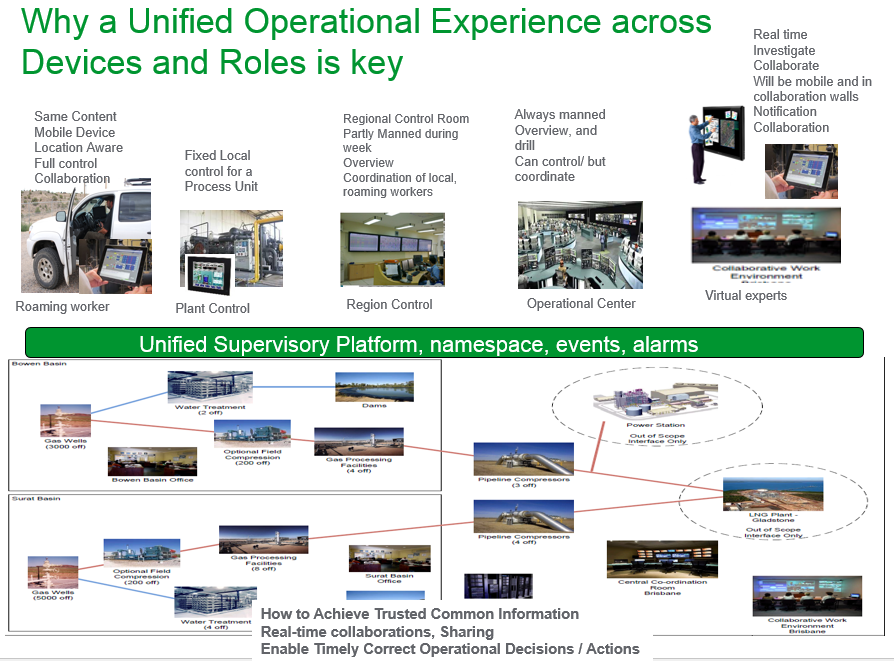
- Where work gets done – local workers are essential, but an increasing use of traveling experts is essential. These experts require standardized, trustworthy, and actionable information in order to add value. Many experts spend more than 50% of their time in unplanned work and processing data to produce trustworthy “wisdom”.
- How work gets done – lean operations depends upon lean work; automation of information processing and distribution is essential. The expert’s private spreadsheets are necessary for testing and innovation, but operations teams can only use and trust standardized, easily accessible and actionable information.
- Who does the work – a central thought in industrial operations is work simplification. Fewer experts are available within the industrial enterprise, and in many locations around the world, younger technical workers refuse to live near the industrial facilities. So much of the knowledge and wisdom must be embedded in the operations management architecture.
This transformation is essential; if there isn’t sufficient
transformation, then Industry 4.0 is wasted.
Industry 4.0 is a practical strategic framework
One way of summarizing the central thoughts of this activity
is that wasted work, cost, time and energy can be eliminated, and the product
lifecycle can be optimized, by exploiting information about product design,
manufacturing, distribution and use throughout the “supply chain”. In order to exploit this information, much
more data is necessary, and it must be transformed with appropriate context
much earlier and to a much greater extent.
The enterprise which can constantly exploit this information has a
sustainable competitive advantage. This
exploiting generates a terminology for the higher value information, such as
the following:
- Data – raw values, automatically sensed and manually entered, including geographical/altitude location, time, and if possible, with asset identification (machine, material, vehicle etc.)
- Information – cleaned and reconciled data and derived information, such as efficiency and statistics
- Knowledge – information in context, including comparisons to targets and constraints, estimated times to thresholds, predicted failures
- Wisdom – optimal targets, prescriptive procedures to address desired and undesired situations
The above terminology is only one of several alternatives,
but all of these address a foundational requirement that Industry 4.0 requires
better information, not just more data.
Industry examples of transformation include:
Discrete and batch industries – accelerated “new product
introduction”. New products can be
introduced earlier, manufacturability effort can be accelerated, and new
learnings can be distributed across multiple manufacturing lines and facilities
much faster.
Mining industry – higher “sales value of product”. Exploiting the detailed knowledge of the
metallurgy in each group of material in each location of the mines, the
stockpiles, processing and transportation can significantly raise shipment
prices and increase revenue.
Petroleum refining and petrochemicals industries – increased
margins. Exploiting the detailed
knowledge of the chemistry of the fluids and the capabilities of the processing
equipment can significantly reduce the cost of raw material purchases and
processing costs for the same output.
Power generation and transmission industries – exploiting
the detailed knowledge of current and upcoming power demand, and knowledge
about current and upcoming capabilities of generation and transmission can
significantly increase reliability, increase revenue and reduce emissions.