Sunday, March 17, 2013

Achieving Operational Effectivness through Planned Operational Work vs Adhoc Work

As one customer said “We have teams and programs on captial asset performance for years, this will continue, but the real opportunity for gains is with increased efficiency across the operational team!”
 
The emergence of “Operational Performance Teams” to work along side the well established “Capital Asset Performance Teams”, with the focus on improving the operational effectiveness of the plants. In today's challenge is how do evolve the workers operational practises into a sustainable model. Moving to planned work vs ad-hoc work in a day and week takes a change in culture but delivers significant results in reliability, improved safety. The key to increased agility is through effective, real Operational Teams, having to collaborate and execute work in a timely manner, with the freedom to pass work items between team members for effective execution.
 
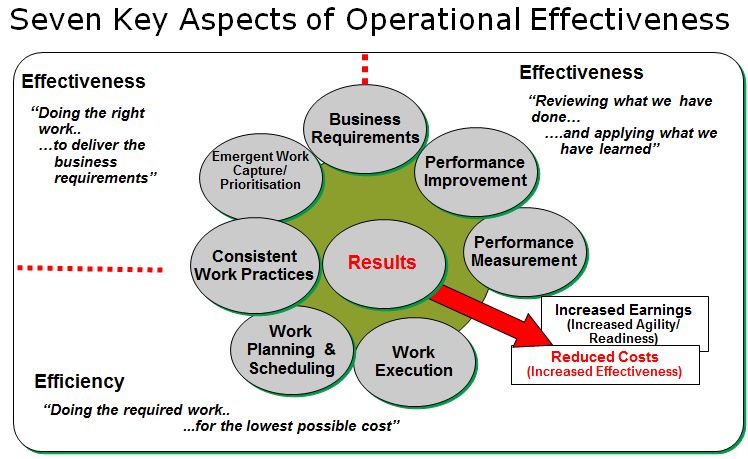
To achieve operational effectiveness the discussion between companies is not just information awareness, it is also looking at implementing operational work item systems that are not just logging and generating end of shift log reports. The discussion has shifted to a “journey of operational alignment and culture” as seen the below. Today many companies find they do not actually know what work items workers are doing in a day, many state that they ad-hoc and fire fighting, which is decidedly in efficient in time and cost, plus directly increases the safety risk. Companies have quoted figures of 35% of a typical plant workers day is planned rest is “unplanned”. The diagram above is intriguing depiction of a possible journey in a workers operational work management, key will be changing the culture of work management on the plant and dynamic workers.
The ISA 95 working group has also released a work management structure for operational systems as seen below:

The key are seven items that are required for Operational Effectiveness:

 
This is decidedly different to traditional electronic log systems, and the key is the fact that this is not a logging and task management, it is also capturing, and planning and assigned embedded operational procedures. The ability to pass work items between different operational team workers. On the plant we do often have a good work management in the Asset Management system, this is extremely effective for asset management, but the Operational Work management is for all items in the industrial landscape, and day. It is also targets improvement by performance monitoring of operational procedure execution and seeing how to improve these procedures. This can only happen if the actions taken are consistent, and this depends on “embedded operational procedures/ workflows”. Combining this with planning and realtime shift dispatching of work items, and constant realtime execution, transferring of work items made up tasks between team members with clear ownership so “accountability” which is key.
Invensys is continuing to evolve it is offering in the space to satisfy the every growing requirement of managing operation work items and therefore the efficiency of the human assets. Working with leading companies as they evolve on this journey of operational effectiveness, expect to see a lot more discussion on this area. My question is how can companies run a team without Operational work items management, that is why electronic log books ave grown in the last few years, but this is only a step in the correct direction.


Sunday, March 10, 2013

“The Future is Here, It is just Unevenly Distributed!”


This statement caught my eye when reading and listening to feedback from this year’s ARC Conference 2 weeks ago. It came from a presentation by John Carey, Vice President of the Aviation, Industrial, Marine, and Energy Business at BP Castrol. Who followed up with another statement that got my interest, and is so true in what I am seeing:

"What keeps me awake at night is that everything that has made my organization successful today will block our success tomorrow."

What a true statement! I just wonder how many people understand it. At a dinner conversation this week I was in a debate on the changing world, and it was clear to all of us that this is not just a technology changing time, but there are three factors all playing at one:

·    Technology is evolving in leaps and bounds, but the role of the internet has had some impact on the industrial world, but nothing compared to what it will have in the next 10 years, where it will change the whole nature of industrial architectures. This is not due to the internet, it is actually due to increased bandwidth of infrastructure and high availability that enables the internet to now leveraged as natural member of the industrial architecture, instead of traditionally for an offline access for information, and basic email, notification capability. The whole ability to share, reliably put systems in the “cloud” and depend on them will enable the designs to accommodate the changing behaviors in the modern business. Mobility plays into this, with the explosion in devices and access, we can now naturally work and act while in a roaming world.

·    Globalization of Business ( “Flat World”): You may say that is old, yes it has been a concept around for a few years, but it is still taking hold but is accelerating at a rapid rate. Chaning the behavior in searching for products, how we buy, how we live our lives, we no longer restrained buy county of regional boundaries, we travel at whim, we communicate, and buy across the world. We all behave in business in a global virtual world. There is not a day goes by when I would not be on at least one meeting where we minimum of 3 continents in the meeting virtually, this is why we don’t work a 9 to 5 day anymore. If businesses are to stay competitive the “holistic” global approach to value supply chain and making it flexible and agile is key, and this drives core behavioral changes.

·    Cultural Shift to Digital Native: enables culture and thinking, driving shorter times in roles, average of 6 careers in a working life, (not counting jobs). The ability multi task, search and filter collaborate with people in more active community vs the traditional day in the life of workers 10 to 15 years ago. This is not a technology change it is a fundamental behavioral/ approach and cultural change form the “baby boomer and 1st half Gen x” to those who were born past 1970 who execute a day totally differently.

Not often in history do you get 3 significant currents of change happen at once with each of the three effecting and enabling the successful passage of change in the other, which will complete the significant transformation in the way operate in the business and industrial worlds by 2020 and 2025.

Mr. Carey discussed both current megatrends and specific technology trends that are already shaping the future of manufacturing. Megatrends include:

Changing demographics and lifestyles

Emerging networks of trust

Hyper-personalization

Digital everywhere

Sustainability

According to Mr. Carey, today's technology trends in communications, transport, processes, energy, and materials are increasing both in terms of their globalization and complexity. “To succeed in this type of environment, manufacturers must innovate, but rather than actually being innovative in everything we do, we often talk about innovation as a separate department. Manufacturers also tend to manage their businesses from the inside out. The real issues are the discontinuities. How can you get your hands around them if you focus internally? Suppliers and customers must work together in strategic relationships. This requires deep trust."  "Today, the customer is king,” said Carey. "This disrupts everything: manufacturing, distribution, and supply chain." In the 20th Century, manufacturers simply designed, manufactured, and marketed their products using the “fire hose” approach. In the 21st Century, however, product design, manufacture, and distribution is increasingly being driven by the customer and his/her individual preferences and requirements.”
 
Stepping back this is not a shock we have seen this in the car manufacturing, but of interest is the rapid transition from managing the process to manufacture goods to “managing the product and that intern manages the processes”. By focusing on the product and value to the customer including quality, satisfaction and timely deliver of value to customer, the competitive position grows. So is born the requirement of “Flexible Operations”.  This is not a “nice to have” it will be a requirement to be competitive in this global market. This can be achieved through an aligned business from business strategy, through operations to process control. Aligned operational teams that span the value chain that enable realtime decisions.

A comment in the ARC conference in Orlando in Feb 2013 was:

"To meet 21st Century demands for mass customization, factories will have to become more intelligent and flexible. "In China, they are not just building more efficient factories, they're building flexible factories," Carey warned." For many leading executives, they feel they have reasonable control over their fixed capital assets not surprising as this mature, but what keeps them awake is the “operational team” the human asset alignment, combined with the agility required surviving in a global “flat “world.

In the mega trends, Carey talked about “sustainability” this is about sustaining the planet, with discussion at ARC conference supported the impact and importance of this moral trend. Yes, a moral trend that driven by customers and market beyond government regulation that consumer (which is the primary focus) has a growing desire to choose a service or product based upon capability and the one that is doing the most on the moral issue of sustainability. This means zero waste and zero emissions both in the manufacturing process and across the total lifecycle of finished products.

As we have discussed a lot in the last year and will no doubt continue, this is not just a technology evolution, it more of a behavioral, cultural evolution that will force a significant change in the way design operational and industrial systems.

Looking out at the industrial landscape, the future has arrived in some parts of the world relative to generation Y and rotating worker (e.g.| China, South Africa, India etc), for some industries many technologies are already here in techniques and materials etc, but not in their industry, yes people have a look outside their industry to see how to achieve the future. Example is the transport industry which leads the dynamic operational centers vs the mining industry that is just starting on that journey. Also in many cases the global business landscape of the future is here and is accelerating in adoption.  
Many companies are well down this evolutionary path changing the operational systems to align with the new business and cultural behavior, but others are approaching the challengers in the traditional automation thinking. It was encouraging to see these topics come to the surface at the ARC Conference in Orlando and be debated, it shows what I am seeing the growing recognition by executives of the extend of the wave change we going to have ride, over the next 10 years.

Saturday, March 2, 2013

Expanding from a Process/ Plant to Holistic Landscape will fuel the debate of “on premise vs off premise”!


I had an an editor speak to me this week about “the shift to Multi Plant view across the industrial landscape, then he mentioned cloud is a dream in Industry”. Quickly correcting him that it should not be a shift to multi plant view versus an expansion on top of the existing local/ remote operational view, and “cloud” is truly real especially with virtual teams, and multi site. This confusion is common at the moment with some vendors and consultants pushing the Enterprise Historian view that really focuses on only one perpective in operations, that of the analyst performance team. That does not mean there is a swing to a new architecture, the architecture must support at least the two communities of interest with different views:

  • Operational day to day teams: requiring a view focused on limited time span e.g.| 7 days and view one process or plant
  • Planning, Management, Performance / optimization teams and expert support teams : wants to look at broader view across sites, and broader time span of months and years usually offline for analysis, and strategic thinking.

The expansion to holistic view will also push the debate of the industrial architecture, to a combination of:

  • On Premise computing: The local plants with real time needs and short time spans will often have the required information and capability local on premise. This can apply also apply in a remote operational center infrastructure which is still local to the remote site, or on the site and just virtualized to the center.
  • Off Premise computing: The shifting of data, analysis, and actions to an off premise computing, either specialised data center, or “cloud” etc, private or public, freeing up the local operational day to day infrastructure from this heavily lifting. Providing also the ideal opportunity merge and consolidate a view and capability across the industrial landscape of a company, this will involve storage, but also realtime model of the production, and operational awareness activities across the different teams.

In the blog on 2020 the following characteristics were expected:

· One in three employees will be working casual, part-time or project base vs career in a company.

· The average tenure in a job / role will be 2.4 years

· One in four workers will be working remotely and virtually.

The ability to see information and data in a near realtime, view according to my focus is key no matter what current device or location being used. The ability to connect, collaborate and share advice is key to decisions in the now and the ability share knowledge when the average experience in a role will be less than 2 years The holistic view will drive many parts of the architecture “off premise” into a managed service.

Three times in a week one in mining two in food, from companies across the world, I was asked to comment on an “End to End” view of information, and especially state. One for operational effectiveness and agility, the other for reduction in delayed time in achieving a “positive release” of products to customers. In both cases the company IT and thought leaders raised both “cloud” and “big data “ techniques. As I mentioned last week, the acceleration in acceptance of these technologies is astounding in the last 6 months.

The mixed reaction to last week blog many agreeing, many debating the reality, but for the second camp, I think they unaware of cost, technology updates, and the expectation of the new generation for doing things fast. Also, there is a shift to be able to buy this holistic capability as  services  vs total up front.

I fundamentally believe that, within 2,  years,  we will laugh at this debate of “on premise” vs “off premise” in the industrial landscape, the modern aligned and agile business will have  an industrial/ operational architecture that naturally applies both On and Off premise computing. “On premise” computing reducing to “only required data/ computing to satisfy the limited operational time span, e.g.| 7days even shorter” everything else will be “off premise”. The landscapes will enable users to view content device independent and across the landscape, but drilling to a plant and process, collaborating across the virtual team from site to corporate to worldwide experts.
Certainly over the next 2 years the expansion in Invensys’s portfolio capability spanning local to enterprise landscape, and include both “on premise” and “off premise” as well as managed services as not a specialty but a natural way to grow value from your systems.

Sunday, February 24, 2013

Are the days numbered for the Servers on the plant vs a remote data center or cloud?


This was a question asked to me this week by an engineer at the New Zealand User Conference, and I stepped back surprised at the question from the remote south island of New Zealand, but pleased. The question was asked with full reality especially around the utility industry such as water etc why would people put in servers today and have all that sustaining hassles, versus just renting space and capability at a managed data center. The point is extremely valid as the networks become more robust, the acceptance of virtualization as the norm to deploy applications, why have the hassle with local servers.

Sunday, February 17, 2013

Accountability Theme Growing in the Industrial Sector!


As the adoption of Flexible Integerated Operational Teams grow, the need to share/pass the execution of work items between team members becomes a requirement. Along with this is the growing theme of "accountability" in the industrial sector at all levels. The challenge with today's social media even email is you copy everyone, so they are all aware, but even this is changing as you need to address the owner of the next action in the "to" address, making it very clear and “accountable”.

Now apply this to operational teams, where the system generates an alarm the owner is the operator on duty, with the responsibility to acknowledge but how does he take action add this to work item list, that will be followed up and resolved:

·         By right clicking he generates a work item, the system prompts which person this is going to or group e.g.| maintenance, process etc, and the work flow will inform that person or group who "accepts ownership" and now they start executing. Already through that work items life time we have had two owners.

·         Now part way through this work item, the shift changes, and the work item appears on the shift handover report, and the new person on the next shift takes ownership of the total outstanding work items, so we have a third owner.

·         Now having completed 3 sub actions in that work item, the current owner, needs have a production department validate the test, so again the work item is reassigned to "production" and ownership stays with the maintenance team, until a particular person in "production" accepts. There is a clear passing and ownership, and accountability of work item.

·         So as, actions and records are captured the full trail to the work item resolution, including time to execute the work item and the action step times are logged and understood.

 
Is this new the answer is "no" plants must have a process for this today, usually paper and knowledge, but as the teams become more dynamic, the paper procedures need to come embedded in the system for consistent execution. Regulation from the market and governments require responsibility to be taken, and when actions are being executed remotely, and workers have more responsibility and work items, the chance of dropping (bot following up and resolving) work items grows.


The leading companies want their strategic targets effecting the targets/ KPIs of all the roles at different levels to be aligned so that as tuning of the strategy happens all people workers accept the change and start executing to that evolved strategy. This is different to a KPI system it is about aligning actions and targets downwards with transformation to local context.

Also leading companies are looking at the operational "day in the life" of their workers and finding two major items:

1/ increasing inconsistency in operational procedure execution from plant to plant, shift to shift, as the workforce transitions and people tenure in a role or location reduces.

2/ that only Approx 35% of work items executed by people on the plant floor are planned at the beginning of a day, the rest are ad hoc from "fire drill" plant actions.

 
Both of these factors have a dramatic effect on:

·         safety

·         regularity compliance

·         efficiency and costs, due to variation in procedure execution time and response action.

·         agility to react to changes in the market.

 
By embedding procedures companies can realize many Operational Goals in controlling their operations such as:

·         Alignment of strategy to all roles activities and targets as they can linked and transformed

·         Consistency in operational procedure execution, combined with the ability tune procedures as they can now monitor how long steps in work items take and improve them.

·          Awareness of outstanding work items, clear ownership providing the ability to increase the planned work in a workers day, so increased efficiency, less chance of safety incidents.
 

In the next week, I will introduce the concepts of operational work management, as a new trend to enable the above.

As plants transform to flexible Integrated Operational teams accountability, ownership, and awareness of outstanding work will become foundational.

Sunday, February 10, 2013

Bring the Problem to the Expert vs Expert to the Problem!!!!! Virtual Expert Communities are required!


 “The 2020 workplace will need to be adept at uniting a physically – present tribe of employees with a tribe of offsite, and often transient, staff. The latter will be specifically chosen for their ability to add value to the task or project, regardless of where they are on the globe.” Mike Miselowski Futurist
This is the concept of flexible operational teams, and the ability unify into a collaborative and sharing environment the people on plants with those outside the plant, and even outside the company or country, who provide expertise. As I continued my travels last week, I engaged with two clients in different industries one in Oil and the other in mining who have remote sites, and the need to bring expertise from elsewhere in their organization to the remote site. These sites are extremely remote, and will involve a day or so travel to get there, and age on the site is reducing and so with it the experience. Both companies talked about getting expertise to site, decisions support centers or often collaborative walls or environments.
Another company in oil and gas last year summed up the problem when he described his team of 35 experts doing 1300+ flights in a year that it was “taking the expert to the problem” and it causing the loss of the expert team as they looked for alternative jobs than living away from family. Also, the response to the problem was delayed, and in many cases the problem did not justify the cost in travel or wasted expert’s time in travel. So his comment,  we need change to a situation where we “take the problem to expert”.
Another company in the metals industry is implementing this on a global basis a community environment across their global experts  with the:
Vision
  • Break Down Communication Barriers between Continents
  • Break Down Communication Barriers between Plants
  • Break Down Cultural/Language Barriers and Inhibitions
  • Break Down Network Barriers Between Computer Systems
  • Create One Secure Global Network accessible by whole Expert Community
  • Standardized system with common variables, standard calculations and standard names for data points for all the like assets / process across the companies worldwide sites.
Goal:

  • Share Experiences with Live & Historical Data
  • Instant online Information Exchange For Problem Solving
  • Create a Powerful Knowledge Database
  • Create a Community For Helping Each Other

So how do you make this a reality?


How do you take experts on the other side of the world, who have not been to a site, and enable them to contribute expertise on a subject, e.g. a particular process on an asset type, to a worker sitting on site. If the expert went to the site, or called the site he would ask a lot of questions on data, status and history to understand the situation before he can contribute.

 So the above company is trying to enable a “facebook” concept across the company pockets of expertise and sites that will actively engage the experts with the operational workers and make an active community, breaking down all the traditional boundaries that prevent this.

To do this they need to:

  • Capture the historical data, current state from the existing systems.
  • They need validate this data to make it trust worthy in their case 100+ rules of integrity
  • They need transform the data into standard measures and states for that process/ asset so that the variables mean the same no matter which plant the expert engages. 
  • The need an operational experience both at the plant, the roaming worker and the virtual expert that naturally enables collaboration in realtime as well as sharing.
All through the last couple of weeks travel, this alignment and empowerment of local people with remote is of significant concern. The tradition Control Room  systems today do not make this part time, transient engagement natural, and it is only by changing the solution to a team/ community, which is available at the local workers finger tips this can become a reality.

This is not something new, people have been trying to implimentation something to enable remote support for years, often throwing technologies such as PC Anywhere etc at it to allow access, and now with the introduction of social media increasing that. Most of it has focused on remote operations from an Operational Center on shore or in a better location. The real step change happens when an active community is developed of experts who collaborate and build knowledge while directly collaborating with the site teams as seen below.
 
Below you can see examples of the Offshore oil industry especially in the north sea what they have been doing while this is a significant step it is only a step, vs and a significant jump to a community.


Yes,  it lines up with Mike Miselowski’s comment of “The 2020 workplace will need to be adept at uniting a physically – present tribe of employees with a tribe of offsite, and often transient, staff.”

Leveraging the social media functions, but in a secure way, that understands security access level, plant control access and location of the people to enable correct engagement levels. So we should not be designing an operation HMI, control room experience , remote access focused on just the plant and process, consideration must be taken how collaboration, and sharing of information will happen in a near real time manner!!  Not just adding messaging, key is making the data and information consistent and trust worthy in near real time, as well as having inbuilt knowledge capture systems.


Sunday, February 3, 2013

Reality of Operational Control through Information, Action and Governance.


Speaking this week with 4 executive vice presidents from different process companies, interestingly that the operational consistency and human factor dominated their concerns. Not the " ageing workforce" factor, these executives are located in South east Asia, where age of the workforce is not a significant factor, but the real challenge of the next operational generation is already becoming apparent, that of " rotating " roles.  The discussion, centered around the requirement for consistency of operation, to enable continuity in safe and optimized production environments. You may ask aren't they concerned about the process control, optimization,  YES, but they realize that it is not about controlling the process it is about optimizing production which requires stable process control, but the key is consistency of operation.
The only way to achieve consistency of operation across production sites and teams, is by embedding process standards that enable alignment of business strategy with action at all levels.
The Real Time Performance Management is more than KPIS and dashboards as so people claim it to be, including:
1/ The correct targets and feedback information for the role and worker in the time, format that reflects his focus.
2/ Alignment of these  targets with the business strategy in real time, propergated to all levels of operations to reflect the strategy
3/ Associated activities and processes that will enable consistent response and action to situations.
4/ Embedded processes in the system to enable consistency of action as workers rotate through roles
 
The rotating worker refers to the growing trend of people staying in a role or location for shorter periods. Example one company stated that they have seen the length of workers in a role or location go from 5 years in 2001, to the tenure now at 8 months. This is a drastic change in anyone's books, but on investigation the other significant change in this company was that the workers in the roles had gone from " baby boomer" to " Gen y" their percentage of late “Gen x” or “Gen y” in the operational workspace was over 40%.
While I believe this to be extreme at this stage, but the clear indicators of what we can expect as we approach 2020 is that 42% of the workforce will be Gen Y. Job tenure will average 2.4 years, but now you add locations and evolution of people within a company, the assumption of experience can not be assumed.
As the executives discussed the need is for alignment across their operations, this means sites, plants, and teams while increasing the empowerment of the worker to make decisions in the now.
 

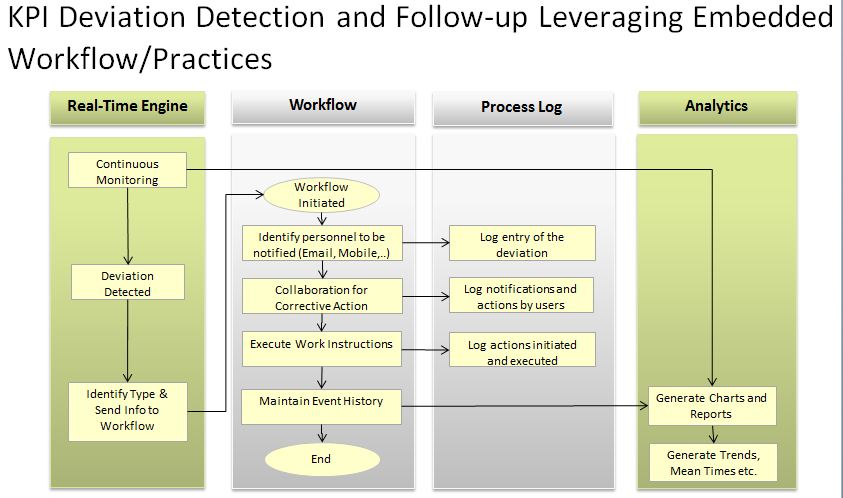
The example above is an embedded operational process, relative a deviation from a KPI that will guide the workers through the desired process, this independent  the user and worker. So instead of just having information, now a work process is built into the system.
The consistency of the answers and focus on the human factor, and enabling users in the dynamic human market was interesting, a clear indicator that this dyanamic role will be natural paradigm in the future.