Showing posts with label workflow. Show all posts

Sunday, September 14, 2014

The Steps on the Operational Journey from Siloed to Optimized to achieve Operational Excellence

We have all seen the debate on how do we go from todays manufacturing to an effective operational landscape, across the full valued supply chain. The increased urgency of this debate has become  recent discussions, I have with different companies; people are trying understand how they going stay competitive delivering the correct products, to the correct markets, locations, in the correct time, at the correct price and margin. All this with increasing costs in labor, energy, transport and regulation compliance.  
The common thread across the discussions was:
·         Real time transparency across all sites, and “cogs” in the supply chain.
·         Shift from “traditional reporting” to “actionable decisions”
·         Shift from operators to “Operational Teams” that align operations, planning and expertise
·         Shift from Siloed process on a plant or across plants to optimized and aligned.
·         Shift from experience in people to experience in the system
·         Alignment and consistency across the operational decisions and action for a product no matter location. 
Providing the foundation for optimizing and continuous improvement, not just of assets but process, assets, product production, and workforce.

Sunday, June 16, 2013

Commentary Feedback on “Third Time Lucky for MOM/ MES!!!! YES, it does have a significant chance this time!!


It is an interesting writing this blog as there is little comment feedback in the blog, but I receive a lot of email on certain subjects with substantial input. The topic of “Third time lucky for MES” I received a lot of both email and discussion face to face, this blog expands on the topic.

The first comment from many people was “that MES has been around for years and has been implemented successfully”, and I agree, but the first 2 generation architectures involved significant services while they have run extremely well for a number of years, but with limited ability to absorb change without significant cost and risk. Also, companies are expanding in multi sites and the requirement to enforce operational practices over multiple sites, again this requires alignment of sites. So yes MES has been successful in concept, but not in a sustaining mechanism.

Charlie’s comment in “The MOM Chronicles” reflects this:

“The first two MOM attempts occurred in the 1990s, and 2000s, actually were also found a primary hindrance to continuous improvement efforts because the MOM system owners were typically understaffed, under skilled, and un governed to support real innovation. “

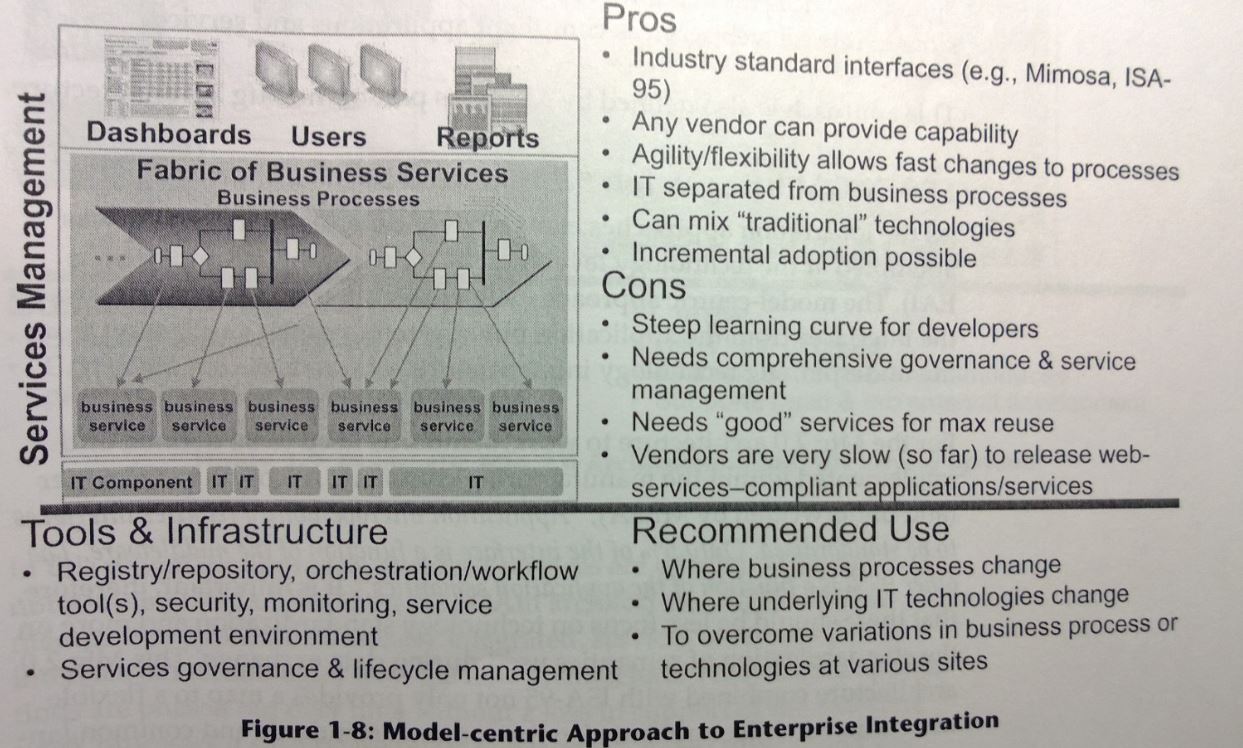
So what is different this time? Was a common question, as mentioned in the original blog the SOA (service Orientated Architecture) actually been adopted correctly with conforming service contracts at the ERP side and business side with the “Enterprise Service Buses” (ESB) becoming a norm, not just a term. This flowing down into the operational world with vendors looking at aligning with web services, but also model centric alignment vs point integration is key. The figure below taken from “The MOM Chronicles” illustrates the concept:

The experience we have MES implementations at Invensys has pushed us to evolve our architecture, and the key areas are:
1/ The MES functional Capability has evolved in richness
2/ The plant events are now linked into the System Platform, using templates so now plant equipment and events can be templates and managed, also validation is achieved as close to source as possible.
3/ The Human interaction and the business rules and processes are no long programmed they are implemented in a model driven (workflow) environment. So now face plates/ forms that present information and interact with humans validate the data entry as early as possible and with no code but in graphical modeling environments. This area alone is transformational as I have sat down with process/ operational teams with these graphical workflows and worked through with them relative to their process, we mark up the diagram and implement fast. No longer programmers are involved in business rules it is the operational/ business / process teams work know their rules and behaviors they require and they implement.
The diagram below shows the realization of the aspects of the Invensys MES architecture, and it is all three aspects that make this a sustainable solution, that scale, and also work in a multiple site situation. But most of all it is agile aware been able to absorb change.  Again this is a different approach to tradition MES solutions which have at MES Functionality, but honestly depended on coding around the system for events, human interaction and business rules. This architecture is SOA so it is plug and play and services like the MES can run in different locations, leaving open the opportunity for MES data bases and rules to run in an elastic “cloud”, combining with the on premise interactions with the plants and people.


Sunday, February 17, 2013

Accountability Theme Growing in the Industrial Sector!


As the adoption of Flexible Integerated Operational Teams grow, the need to share/pass the execution of work items between team members becomes a requirement. Along with this is the growing theme of "accountability" in the industrial sector at all levels. The challenge with today's social media even email is you copy everyone, so they are all aware, but even this is changing as you need to address the owner of the next action in the "to" address, making it very clear and “accountable”.

Now apply this to operational teams, where the system generates an alarm the owner is the operator on duty, with the responsibility to acknowledge but how does he take action add this to work item list, that will be followed up and resolved:

·         By right clicking he generates a work item, the system prompts which person this is going to or group e.g.| maintenance, process etc, and the work flow will inform that person or group who "accepts ownership" and now they start executing. Already through that work items life time we have had two owners.

·         Now part way through this work item, the shift changes, and the work item appears on the shift handover report, and the new person on the next shift takes ownership of the total outstanding work items, so we have a third owner.

·         Now having completed 3 sub actions in that work item, the current owner, needs have a production department validate the test, so again the work item is reassigned to "production" and ownership stays with the maintenance team, until a particular person in "production" accepts. There is a clear passing and ownership, and accountability of work item.

·         So as, actions and records are captured the full trail to the work item resolution, including time to execute the work item and the action step times are logged and understood.

 
Is this new the answer is "no" plants must have a process for this today, usually paper and knowledge, but as the teams become more dynamic, the paper procedures need to come embedded in the system for consistent execution. Regulation from the market and governments require responsibility to be taken, and when actions are being executed remotely, and workers have more responsibility and work items, the chance of dropping (bot following up and resolving) work items grows.


The leading companies want their strategic targets effecting the targets/ KPIs of all the roles at different levels to be aligned so that as tuning of the strategy happens all people workers accept the change and start executing to that evolved strategy. This is different to a KPI system it is about aligning actions and targets downwards with transformation to local context.

Also leading companies are looking at the operational "day in the life" of their workers and finding two major items:

1/ increasing inconsistency in operational procedure execution from plant to plant, shift to shift, as the workforce transitions and people tenure in a role or location reduces.

2/ that only Approx 35% of work items executed by people on the plant floor are planned at the beginning of a day, the rest are ad hoc from "fire drill" plant actions.

 
Both of these factors have a dramatic effect on:

·         safety

·         regularity compliance

·         efficiency and costs, due to variation in procedure execution time and response action.

·         agility to react to changes in the market.

 
By embedding procedures companies can realize many Operational Goals in controlling their operations such as:

·         Alignment of strategy to all roles activities and targets as they can linked and transformed

·         Consistency in operational procedure execution, combined with the ability tune procedures as they can now monitor how long steps in work items take and improve them.

·          Awareness of outstanding work items, clear ownership providing the ability to increase the planned work in a workers day, so increased efficiency, less chance of safety incidents.
 

In the next week, I will introduce the concepts of operational work management, as a new trend to enable the above.

As plants transform to flexible Integrated Operational teams accountability, ownership, and awareness of outstanding work will become foundational.

Sunday, November 11, 2012

Time for “Off the Shelf” Operations/ MES Solution

As I sit on another plane heading across the Pacific from California, I have time to reflect on the discussions both this week, and over the last 6 months, with leading food and beverage and process companies.
The growing trend in the MES space, (which the dominate solution is “custom solutions”), is to replace these systems with “off the shelf” products, enabling companies to focus on the core business. This trend is similar to the ERP space in the 90s, and initially in the MES space in the late 90s, and 2000s, but MES solutions of this time did not deliver the complete solution, and the eventual solutions have become unsustainable for the “operational journey”. Thousands of sites have installed MES Products from Invensys and other vendors, that are  highly successfully having run for over decade delivering significant value, but this time around there is more functionality capability people want, the architecture is not just one plant but multiple, and tolerance for custom code has significantly dropped. So why? And why now?

Sunday, March 18, 2012

Business Control Loop Concept Critical for Continued Process Improvement.
Nearly all customers/ end users I am talking with across multiple industries have a “lean/ performance program” looking at business processes and supply chain. Many have adopted techniques such as Lean/ Six Sigma, and many have a dedicated team investigating and driving performance thinking across the different aspects of the business.
The diagram below came from ARC on a survey they did, but it is the best depiction I have seen how the leading customers gain an advantage by embedding processes vs just training and manual implementation. The leading companies are looking take this embedded process, to the operational space, and again this becomes critical in the “rotating” worker world.