Showing posts with label collberation. Show all posts

Sunday, February 10, 2013

Bring the Problem to the Expert vs Expert to the Problem!!!!! Virtual Expert Communities are required!


 “The 2020 workplace will need to be adept at uniting a physically – present tribe of employees with a tribe of offsite, and often transient, staff. The latter will be specifically chosen for their ability to add value to the task or project, regardless of where they are on the globe.” Mike Miselowski Futurist
This is the concept of flexible operational teams, and the ability unify into a collaborative and sharing environment the people on plants with those outside the plant, and even outside the company or country, who provide expertise. As I continued my travels last week, I engaged with two clients in different industries one in Oil and the other in mining who have remote sites, and the need to bring expertise from elsewhere in their organization to the remote site. These sites are extremely remote, and will involve a day or so travel to get there, and age on the site is reducing and so with it the experience. Both companies talked about getting expertise to site, decisions support centers or often collaborative walls or environments.
Another company in oil and gas last year summed up the problem when he described his team of 35 experts doing 1300+ flights in a year that it was “taking the expert to the problem” and it causing the loss of the expert team as they looked for alternative jobs than living away from family. Also, the response to the problem was delayed, and in many cases the problem did not justify the cost in travel or wasted expert’s time in travel. So his comment,  we need change to a situation where we “take the problem to expert”.
Another company in the metals industry is implementing this on a global basis a community environment across their global experts  with the:
Vision
  • Break Down Communication Barriers between Continents
  • Break Down Communication Barriers between Plants
  • Break Down Cultural/Language Barriers and Inhibitions
  • Break Down Network Barriers Between Computer Systems
  • Create One Secure Global Network accessible by whole Expert Community
  • Standardized system with common variables, standard calculations and standard names for data points for all the like assets / process across the companies worldwide sites.
Goal:

  • Share Experiences with Live & Historical Data
  • Instant online Information Exchange For Problem Solving
  • Create a Powerful Knowledge Database
  • Create a Community For Helping Each Other

So how do you make this a reality?


How do you take experts on the other side of the world, who have not been to a site, and enable them to contribute expertise on a subject, e.g. a particular process on an asset type, to a worker sitting on site. If the expert went to the site, or called the site he would ask a lot of questions on data, status and history to understand the situation before he can contribute.

 So the above company is trying to enable a “facebook” concept across the company pockets of expertise and sites that will actively engage the experts with the operational workers and make an active community, breaking down all the traditional boundaries that prevent this.

To do this they need to:

  • Capture the historical data, current state from the existing systems.
  • They need validate this data to make it trust worthy in their case 100+ rules of integrity
  • They need transform the data into standard measures and states for that process/ asset so that the variables mean the same no matter which plant the expert engages. 
  • The need an operational experience both at the plant, the roaming worker and the virtual expert that naturally enables collaboration in realtime as well as sharing.
All through the last couple of weeks travel, this alignment and empowerment of local people with remote is of significant concern. The tradition Control Room  systems today do not make this part time, transient engagement natural, and it is only by changing the solution to a team/ community, which is available at the local workers finger tips this can become a reality.

This is not something new, people have been trying to implimentation something to enable remote support for years, often throwing technologies such as PC Anywhere etc at it to allow access, and now with the introduction of social media increasing that. Most of it has focused on remote operations from an Operational Center on shore or in a better location. The real step change happens when an active community is developed of experts who collaborate and build knowledge while directly collaborating with the site teams as seen below.
 
Below you can see examples of the Offshore oil industry especially in the north sea what they have been doing while this is a significant step it is only a step, vs and a significant jump to a community.


Yes,  it lines up with Mike Miselowski’s comment of “The 2020 workplace will need to be adept at uniting a physically – present tribe of employees with a tribe of offsite, and often transient, staff.”

Leveraging the social media functions, but in a secure way, that understands security access level, plant control access and location of the people to enable correct engagement levels. So we should not be designing an operation HMI, control room experience , remote access focused on just the plant and process, consideration must be taken how collaboration, and sharing of information will happen in a near real time manner!!  Not just adding messaging, key is making the data and information consistent and trust worthy in near real time, as well as having inbuilt knowledge capture systems.


Sunday, September 23, 2012

The Changing Approach to Enabling the Two Key Assets (Captial/ Human) in Plants

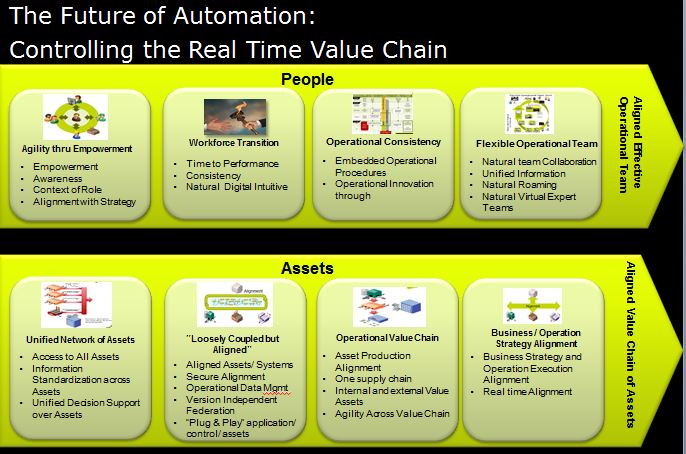
For the last 5 months, you have read about different aspects of what is happening in the market in order to achieve OPERATIONAL EXCELLENCE. Realistically it comes down to two key operational concepts:
·          The aligning of the HUMAN ASSETS into an Operational Team operating in the NOW.
·          The aligning of CAPITAL ASSETS into a co-ordinated Supply chain, and not islands of automation.
Talking to people they are all different levels on these two areas, but most focus on Captial Asset performance, yes plant/ equipment utilization. People talk about providing information to “Joe” the operator, but miss the point that information is only part of the journey, decisions and actions need also to happen in a timely manner.
The diagram below illustrates the main elements of these two alignment strategies which leading companies are applying to a different level:

Tuesday, April 24, 2012

Activities Behavior Starts to become Reality
As I flex back from South Africa last week I was listening to an interview on innovation, and there was interview with Microsoft Manager for Australia, and she talked about the change in culture they have implemented in the Australian offices. Switching to Activity based officers meaning that no one has a permanent seat or desk, you go in a morning and select a desk based upon the activity you are doing that day. As you may be on the road, you may be do activities that do not need you in the office, you maybe at other offices. She talked about it as a significant change in culture but it allows agility and focus to adapt your day and role based upon activities not a role.
This is the same I see in my own life and how I have discussed realtive to the Flexible Operational Team in the industrial space, these can only be achieved when people and the culture support an Activity Based thinking and Approach. In South Africa last week, I continued to see the evolution towards this thinking in mining, and food and beverage as I spoke with customers, many do not realise they on this path, yet their actions and ideas are heading in this direction.

This is no different in my life every day, I talk about my work life being in my back pack, with my lap top, IPad, mobile cell, and mobile  wireless hotspot. Based upon the activities I have that day, meetings, calls, site visits, PowerPoint presentation preparations, technology knowledge catch up, interviews,  strategy brainstorming, these are distinct activities require different modes of thinking, I choose the best environment and location for doing these.
This is very different to the way I worked 10 to 15 years ago in an office and defined role, today my activities and role change daily based on the situation and achieving our business goals and the contribution I can make each day to that, certainly my agility, and effective working time and delivery has increased.
This is the same for the industrial world and the changing approach I am seeing in the industrial place, where companies are going to the Flexible Operational Team, as mentioned a couple of weeks ago, can only be truly achieved when people are working against activities vs roles. Key to evolution is that there will be a management of activities, both planned and reactionary, which will be acted upon by the best person, or team in order to respond as fast as possible. This does not mean that people are assigned to a certain interface/ roles,  they should be able to go to best location in the plant in order to execute that activity. This is why the whole operational control is evolving to a an aligned set of systems, that allow people to access, understand and take action in the most effective place possible.


 I was in South Africa at the annual conference there, as usual I saw a lot of innovation, and thought leadership, building on what I have seen in Western Australia in the last 6 months. The big discussion was around effectively using the human asset, through "time to Experience shortening" knowledge access, and actions, and collberation.
 But you see this continued evolution from:
Applications        to        Roles        to         Activities
Activities require a change in thinking:
·         How align information and actions from different systems to enable a co-ordinated and assignable activity.
·         How the UI changes to activities with the information, ability drill and understand and then the associated actions, which may require multiple people and certain procedure.
·         Plus a culture that allows roles and people to be flexible to take on different activities in a must more agile process.
I will expect to see this activity thinking and approach accelerating over the next year but as I have said this means aligned systems, access, and contextualization in order to make it fully effective.  

Sunday, March 25, 2012

The Changing Execution of Flexible Operational Team

“What does Operational Collaboration Mean for my Modern Supervisory System?”
Last week I travelled to Western Australia, a state where there is a significant mining boom, and a challenge of how to operate it’s plants with a 3 way changing market:
·          The need to be agile to maximize production, which drives a push towards streamlining  “Value Generating Assets”.
·          The shortage of skill sets and experience
·          The changing demographic of the workforce to a younger more “digitally native” aware personal
As I spoke with people in the industry from engineering to operations, the topics I have been discussing in this blog over the last couple of months were confirmed. It does require a different thinking on how to put a system together, and not just different technologies but also an awareness in the design of the system of the constraints these new dynamics bring. This is calling for a rethink of operational practices and collaboration in real-time, to enable the “Flexible Operational Team Work” required, this goes beyond “Operational Centers” it is a new level teamwork, which will require a new thought pattern when designing the operational systems.