Showing posts with label Embedded workflows. Show all posts

Sunday, February 14, 2016

Composite Frameworks What are They, the shift to Model Driven vs Custom: How do they Play?

As we look at MES and Operational solutions the role of the consistent operational execution and experience is key to achieving operational consistency. No matter the product at the back end the "operational experience" must be role based and transverse the products in the back end, and transform the experience from application configuration to "task/activity" based experience.

Traditionally companies have built User Interfaces to an API, with the calls needed to execution actions and transactions; these have worked well especially within a plant. But a key to operational systems being effective and agile is their ability to adapt on a regular basis, this requires a sustainable and evolving system. This is especially important in form/ transaction activities where information is provided and where actions/ data input, and procedures  that need to be carried out. But the challengers of operational procedures:

  1. Operational Process cross-over functional domains and applications
  2. Lack of governance
  3. AgilityResponsive manufacturing business processes
  4. Increase the performance of their people assets
  5. Too much Custom Code, making it unmanageable and evolutionary
So like the Business System who started introduce BPM (Business Process Modeling) leading companies in the industrial space are looking and asking why they cannot apply the same techniques in the Industrial/ production sector.


There is no reason why not! Yes the time line is more real time, triggers are real-time, and we many roles with different time dimensions. But this also aligns with what the industrial world is very comfortable world with that of “stable in control loops” we do this in automation with feedback (information) and correction (actionable procedures), what we are looking at are “operational loops”.

Providing a graphical configuration environment for the capture and defining of operational process including the validation of data input, and guide actions, working inline with the user Interface/ forms etc. Providing a framework for building of reusable forms, and reusable procedures that can be managed as templates and standards to enforce consistent operational practices. Empowering the operational domain people to develop, evolve and manage their procedures.

Most of all empowering the different roles in the plant, that operational close loop moving to an “activity” centric system where information, and action is driven from a consistent operational model and practices.

Sunday, February 3, 2013

Reality of Operational Control through Information, Action and Governance.


Speaking this week with 4 executive vice presidents from different process companies, interestingly that the operational consistency and human factor dominated their concerns. Not the " ageing workforce" factor, these executives are located in South east Asia, where age of the workforce is not a significant factor, but the real challenge of the next operational generation is already becoming apparent, that of " rotating " roles.  The discussion, centered around the requirement for consistency of operation, to enable continuity in safe and optimized production environments. You may ask aren't they concerned about the process control, optimization,  YES, but they realize that it is not about controlling the process it is about optimizing production which requires stable process control, but the key is consistency of operation.
The only way to achieve consistency of operation across production sites and teams, is by embedding process standards that enable alignment of business strategy with action at all levels.
The Real Time Performance Management is more than KPIS and dashboards as so people claim it to be, including:
1/ The correct targets and feedback information for the role and worker in the time, format that reflects his focus.
2/ Alignment of these  targets with the business strategy in real time, propergated to all levels of operations to reflect the strategy
3/ Associated activities and processes that will enable consistent response and action to situations.
4/ Embedded processes in the system to enable consistency of action as workers rotate through roles
 
The rotating worker refers to the growing trend of people staying in a role or location for shorter periods. Example one company stated that they have seen the length of workers in a role or location go from 5 years in 2001, to the tenure now at 8 months. This is a drastic change in anyone's books, but on investigation the other significant change in this company was that the workers in the roles had gone from " baby boomer" to " Gen y" their percentage of late “Gen x” or “Gen y” in the operational workspace was over 40%.
While I believe this to be extreme at this stage, but the clear indicators of what we can expect as we approach 2020 is that 42% of the workforce will be Gen Y. Job tenure will average 2.4 years, but now you add locations and evolution of people within a company, the assumption of experience can not be assumed.
As the executives discussed the need is for alignment across their operations, this means sites, plants, and teams while increasing the empowerment of the worker to make decisions in the now.
 

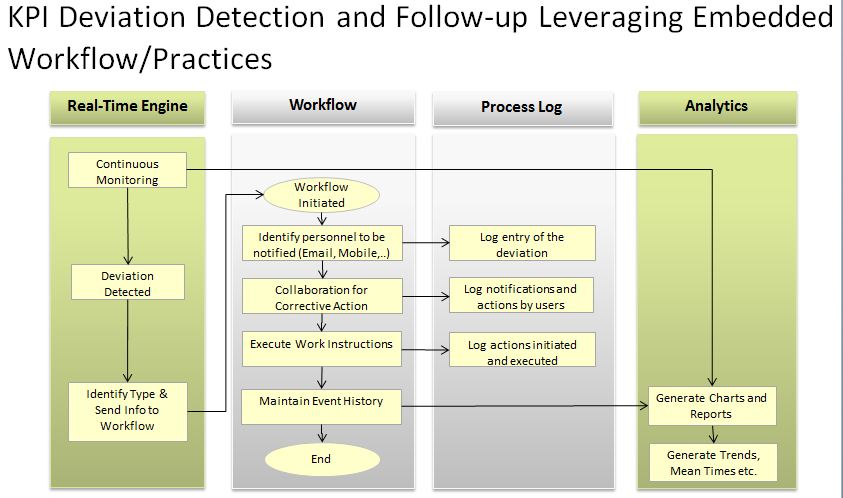
The example above is an embedded operational process, relative a deviation from a KPI that will guide the workers through the desired process, this independent  the user and worker. So instead of just having information, now a work process is built into the system.
The consistency of the answers and focus on the human factor, and enabling users in the dynamic human market was interesting, a clear indicator that this dyanamic role will be natural paradigm in the future.