Showing posts with label Manufacturing Operations Management. Show all posts

Thursday, October 22, 2015

Help Operators move from “Coping” to beyond “Optimizing”

This is a great blog from Stan DeVries, really opening some of the challenge thinking.

"A recent meeting with a customer discussed the best practices for centralized control rooms and integrated operations centers.  They summarized 4 levels of operator performance:
  •         Coping
  •          Aligning
  •          Optimizing
  •          Stretching

While the focus of the meeting was on optimizing, the customer pointed out that we must enable the newer operators who begin by “coping”.  It is worthwhile to consider the differences between these 4 levels:

  •         Coping requires high concentration on operations activity and events, where the operator has little flexibility to adapt to teamwork with other operators.  The operator has been qualified to work in a centralized control room or integrated operations center, but they have difficulty to maintain pace.
  •   Aligning requires moderate concentration, where the operator can safely and reliably adapt to most of the teamwork activity, but reaching team targets is still difficult, such as value chain efficiency or throughput.
  •   Optimizing requires a different type of concentration, where the operator has learned how to cope and how to align, but now the operator focuses on achieving the team targets, and the targets change periodically – in some industries (e.g. power generation and natural gas liquids processing) the targets change every 15 minutes.
  •   Stretching is achieved by “error free” operators who have learned how to beat the optimization targets.


The key question is how can operators achieve and sustain best performance?  A quick answer is more training, but too often the training paradigm isn’t adequate.  Best practices have shown that the effective method is treating the targets like a game, and applying newer visualization to support it.  Before we look at any example of a “game” or possible visualization, we need to consider the innovation in the training approach:

  •          Training becomes holistic – the students learn about how to perform in team settings
  •          Training moves beyond the classroom – classroom training is essential, but structured on-         the-job training becomes very important
  •          Operator performance becomes less “private” – team performance is visible and shared.


So what can the new training experience feel like?  Consider an example which has been published in regional industry conferences, where the initial focus was optimizing energy across multiple sites and all operating shifts:


The dark blue diamonds is hourly efficiency performance over a wide range of throughput, across all sites and all shifts.  The magenta squares are the result of one month of teamwork, and the yellow triangles are the results after two months.  Please observe a few key characteristics of this experience:
  • Very dynamic operating conditions
  • “Blind” presentation – operator names are not shown
  • Graphical context – instead of bar or gauge displays, operators see how their performance compares with others.

The operator is given other detailed displays both during training and for normal operation, but the exercise is focused on teamwork.  Consider the significant improvement in the above displays."

Monday, January 5, 2015

Top 10 Manufacturing Operations Blogs for 2014


Many of you probably already are subscribed to MOM blogs, but just in case you not I though these top 10 showed some interesting thoughts.


http://cerasis.com/2014/12/22/top-10-manufacturing-blog-posts-2014/


On my blog the two topics which had a number of blog posts, but had highest hits were around:

1/ Situational Awareness , and change in the way we must design based upon impact
2/ Internet of Things and Cloud.

Interesting the year before cloud and internet of things created very little interest, but this aligns with significant growth in interest in these topics in 2014, and will only grow further into solid reality in 2015.
Enjoy 

Sunday, June 16, 2013

Commentary Feedback on “Third Time Lucky for MOM/ MES!!!! YES, it does have a significant chance this time!!


It is an interesting writing this blog as there is little comment feedback in the blog, but I receive a lot of email on certain subjects with substantial input. The topic of “Third time lucky for MES” I received a lot of both email and discussion face to face, this blog expands on the topic.

The first comment from many people was “that MES has been around for years and has been implemented successfully”, and I agree, but the first 2 generation architectures involved significant services while they have run extremely well for a number of years, but with limited ability to absorb change without significant cost and risk. Also, companies are expanding in multi sites and the requirement to enforce operational practices over multiple sites, again this requires alignment of sites. So yes MES has been successful in concept, but not in a sustaining mechanism.

Charlie’s comment in “The MOM Chronicles” reflects this:

“The first two MOM attempts occurred in the 1990s, and 2000s, actually were also found a primary hindrance to continuous improvement efforts because the MOM system owners were typically understaffed, under skilled, and un governed to support real innovation. “

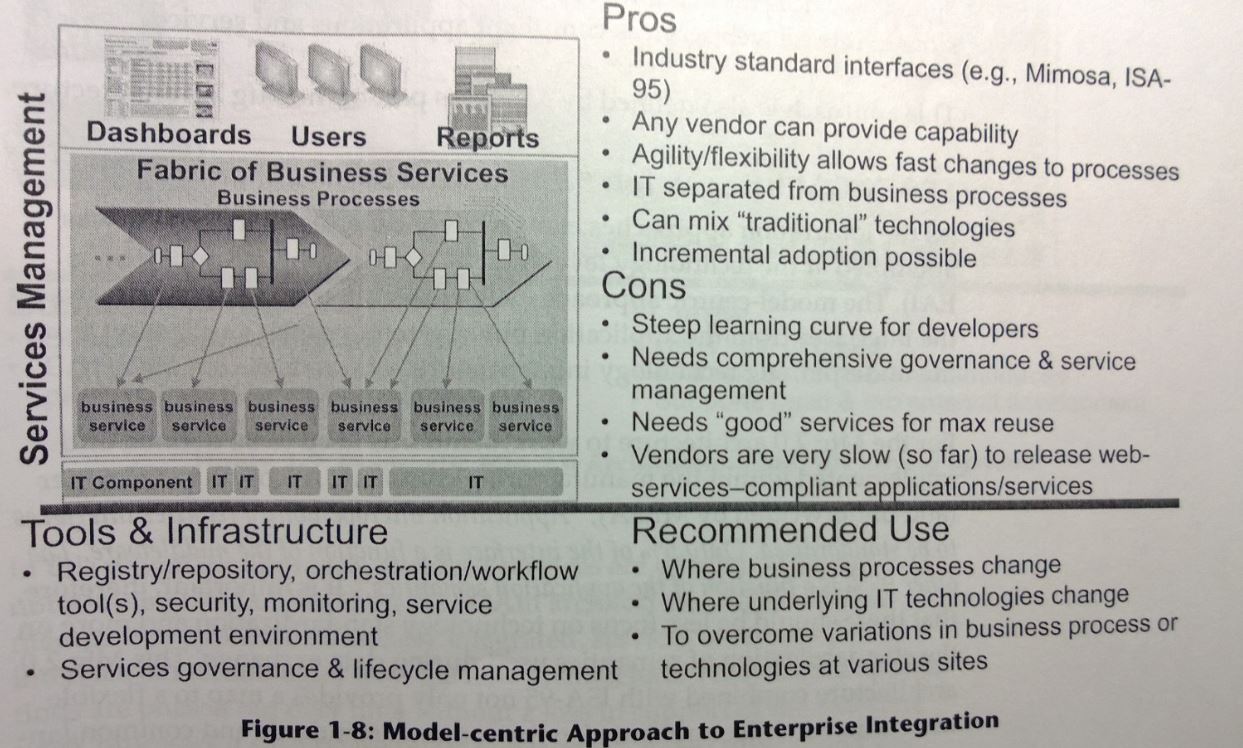
So what is different this time? Was a common question, as mentioned in the original blog the SOA (service Orientated Architecture) actually been adopted correctly with conforming service contracts at the ERP side and business side with the “Enterprise Service Buses” (ESB) becoming a norm, not just a term. This flowing down into the operational world with vendors looking at aligning with web services, but also model centric alignment vs point integration is key. The figure below taken from “The MOM Chronicles” illustrates the concept:

The experience we have MES implementations at Invensys has pushed us to evolve our architecture, and the key areas are:
1/ The MES functional Capability has evolved in richness
2/ The plant events are now linked into the System Platform, using templates so now plant equipment and events can be templates and managed, also validation is achieved as close to source as possible.
3/ The Human interaction and the business rules and processes are no long programmed they are implemented in a model driven (workflow) environment. So now face plates/ forms that present information and interact with humans validate the data entry as early as possible and with no code but in graphical modeling environments. This area alone is transformational as I have sat down with process/ operational teams with these graphical workflows and worked through with them relative to their process, we mark up the diagram and implement fast. No longer programmers are involved in business rules it is the operational/ business / process teams work know their rules and behaviors they require and they implement.
The diagram below shows the realization of the aspects of the Invensys MES architecture, and it is all three aspects that make this a sustainable solution, that scale, and also work in a multiple site situation. But most of all it is agile aware been able to absorb change.  Again this is a different approach to tradition MES solutions which have at MES Functionality, but honestly depended on coding around the system for events, human interaction and business rules. This architecture is SOA so it is plug and play and services like the MES can run in different locations, leaving open the opportunity for MES data bases and rules to run in an elastic “cloud”, combining with the on premise interactions with the plants and people.


Friday, May 10, 2013

Third Time Lucky for MOM/ MES Architectures?


For the last 15 to 20 years companies have implemented MES (Manufacturing Execution System)  systems, and MOM (Manufacturing Operations Management) systems, remembering MOM is a super set of MES. These implementations executions have been both custom, and using off the shelf applications for MES, and success has varied, but even the successful ones are struggling to evolve to current agile requirements due to the method of implementation. One end user asked me on the flight “has MES been successful?”, I stepped back and thought about a couple customs who have implemented end to end MES. Based on one MES system so that manufacturing master data is managed by one system, with the customer stating their MES has been the most valuable software implementation on the plants, it just works and is the heart of their manufacturing. So the answer is yes, but the fact of the question allowed me to reflect on the normal bumpy roads MES implementations have had.

Sunday, April 28, 2013

Can Sustainable Manufacturing Operations Management Exist without Master Data Management? NO,


Again last week the discussion of operational integration raged in few project discussions with customers, without really understanding the arguments and I needed to pull out a log from mid last year on Operational Data Management. Data Model Alignment will be key in a viable interoperability architecture for level 3 applications with out “rip and replace approach” in making Manufacturing Operations Management sustainable and effective.    

Synching between systems, people look at data warehouses , they do manual binding, but these are just not practical in a sustainable and every changing world. There are many systems usually upwards of 20 + systems which come from different vendors and even if they do come from the same vendor they implemented by different cultures in the plants. The thought pattern on “just asset naming” is different between these groups. So the concept of Master Data Management (MDM) for Industry is a hidden one, but we believe is a key one for the future of sustainable solutions that are federating multiple systems together, so expect to see investments and products to trying to address this. In this blog I want to have a discussion on why MDM what it is, and Gerhard has done a good job, and I will expand on it.