It is an interesting writing this blog as there is little
comment feedback in the blog, but I receive a lot of email on certain subjects
with substantial input. The topic of “Third time lucky for MES” I received a
lot of both email and discussion face to face, this blog expands on the topic.
The first comment from many people was “that MES has been
around for years and has been implemented successfully”, and I agree, but the
first 2 generation architectures involved significant services while they have
run extremely well for a number of years, but with limited ability to absorb
change without significant cost and risk. Also, companies are expanding in
multi sites and the requirement to enforce operational practices over multiple
sites, again this requires alignment of sites. So yes MES has been successful
in concept, but not in a sustaining mechanism.
Charlie’s comment in “The MOM Chronicles” reflects this:
“The first two MOM attempts occurred in the 1990s, and
2000s, actually were also found a primary hindrance to continuous improvement
efforts because the MOM system owners were typically understaffed, under
skilled, and un governed to support real innovation. “
So what is different this time? Was a common question, as mentioned
in the original blog the SOA (service Orientated Architecture) actually been adopted
correctly with conforming service contracts at the ERP side and business side
with the “Enterprise Service Buses” (ESB) becoming a norm, not just a term.
This flowing down into the operational world with vendors looking at aligning
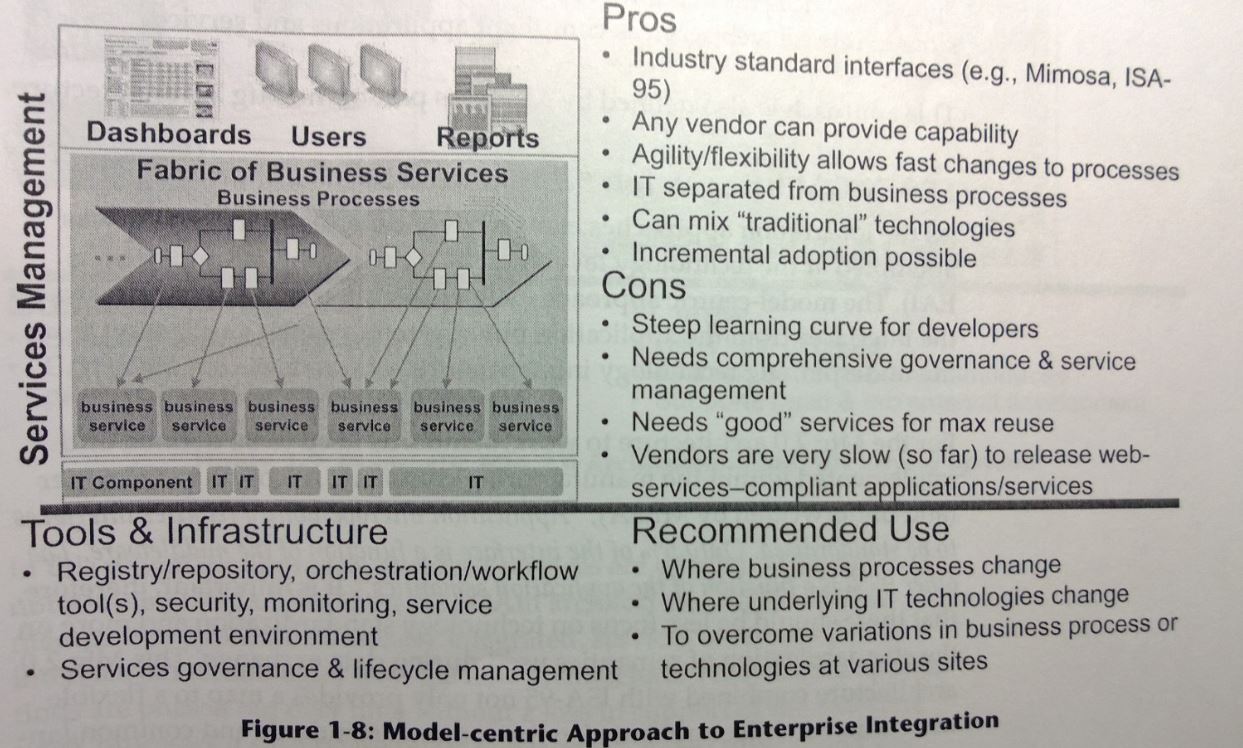
with web services, but also model centric alignment vs point integration is
key. The figure below taken from “The MOM Chronicles” illustrates the concept:
The experience we have MES implementations at Invensys has
pushed us to evolve our architecture, and the key areas are:
1/ The MES functional Capability has evolved in richness
2/ The plant events are now linked into the System Platform,
using templates so now plant equipment and events can be templates and
managed, also validation is achieved as close to source as possible.
3/ The Human interaction and the business rules and
processes are no long programmed they are implemented in a model driven
(workflow) environment. So now face plates/ forms that present information and
interact with humans validate the data entry as early as possible and with no
code but in graphical modeling environments. This area alone is
transformational as I have sat down with process/ operational teams with these
graphical workflows and worked through with them relative to their process, we
mark up the diagram and implement fast. No longer programmers are involved in
business rules it is the operational/ business / process teams work know their
rules and behaviors they require and they implement.
The diagram below shows the realization of the
aspects of the Invensys MES architecture, and it is all three aspects that make
this a sustainable solution, that scale, and also work in a multiple site
situation. But most of all it is agile aware been able to absorb change. Again this is a different approach to
tradition MES solutions which have at MES Functionality, but honestly depended
on coding around the system for events, human interaction and business rules.
This architecture is SOA so it is plug and play and services like the MES can
run in different locations, leaving open the opportunity for MES data bases and
rules to run in an elastic “cloud”, combining with the on premise interactions
with the plants and people.
