Showing posts with label operational empowerment. Show all posts

Sunday, March 8, 2015

Cost of Delay: Realtime Actionable Decisions Critical at all Layers in Industrial Operations

In a number of recent discussions with people when they have listened to sessions on the operational transform and the concepts of people and team transformation, they incorrectly feel the focus is only on the  “operator”. While the operator is the closest person to the “coal face” a fundamental concept of the operational transformation are the shifts to:
·         Actionable decisions performed as early as possible
·         Collaboration across the operational team in making the decision, and taking the action
·         Sharing of current situation and experience
·         Awareness of the situation as early as possible.


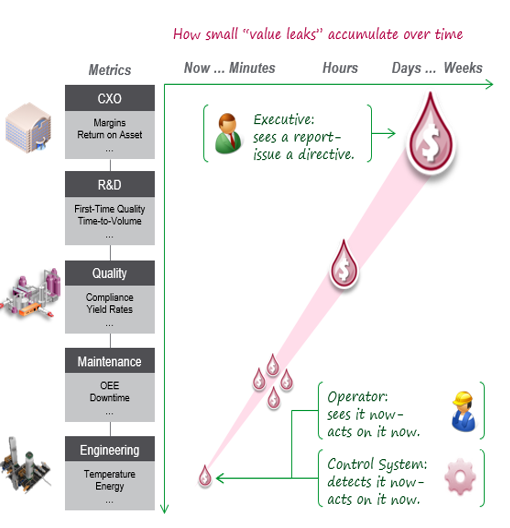
As seen in the diagram below if a situation is left then by the time it hits the weekly report even daily report the cost of the situation is significant.

Monday, July 7, 2014

Smart Plant a Realistic / Holistic View

Smart Cities, Smart Airports, Smart Farms, Smart Upstream Fields are all the talk, but when you get down to interviews with companies, cities etc, the definitions change from city to city, from major oil company to another, so if you looking for a clean definition it not to be found. But there are underlying trends you see across all of them:
Trends/ Objectives:
·         Faster decisions and less people monitoring / responsible for more. Leading to the Integrated Operational (control) centers.
·         Increased agility and efficiency through transparency across the whole landscape, so better alignment to plans
·         Increased Operational Continuity
·         Lowering of cost through increased understanding of operations, and operational efficiency of assets. Energy management and material management.
·         The Operational Workforce transition of experience and to a dynamic, digital workforce.
·         Environmental/ Safety and regulation control, limiting exposure and cost
·         Change of equipment/ instruments to “smart equipment” which have increased intelligence and “self monitoring” , a dramatic increase in data that needs to be understood, and used for more predictive awareness
Yes this is all a part of the Operational Transition I have been talking about, and believe will transform the industrial sector over the next 5 to 10 years, as part of the 3rd industrial revolution.
But in the last couple of weeks we have worked with a company in Asia who has a really good grasp of “smart plant” and the overall concepts that need to addressed in their journey.

They are really looking at the 4 main themes with their unique names, but they also looking across these and how they interact, as well not just a plant but across assets.
This is built on their belief that Operational Workspace is changing and not in one area but multiple dimensions, with workforce change, but also ICT changes like “cloud," “Bandwidth," IOT (Internet of Things), Smart / intelligent devices, and the move to naturally using simulation.
The diagram below shows the two big axis they see changing, not too different to People and Asset changes we have seen before.
An interesting observation is the shift to “larger, more complex process” this is true in all industries, as the problem we are being asked to solve is significant compared with the traditional control, but the opportunity for return is significant as well. But with the use of centralized computing, and shared learning, the cost, and ability to solve these today over all size plants is possible.
In reality the fact that this company has engaged on journey and understands it is journey is important, understands the goals, and direction, the shift to manage “work” and transition their architecture to embrace “intelligent devices” so they can leverage the IoT developments and Big Data, Industrial Analytics. Probably means they will lead the transition and be positioned well in the new world beyond 2020, but we all entering this world!     

Sunday, July 21, 2013

Google Glass Comes to Manufacturing


The concept of introducing “multi Sourcing” and then displaying through “augmentation” is not new. Google has playing around with glasses for some time. Do you need Google Glasses to leverage augmentation NO. You could have an IPAD as worker companion showing information relative to the users orientation and focus. Similar to the “Starwalk” application you can download for your IPAD which allows you point up the night skies and see what stars in the orientation.

I was sent this article last week “google Glass in Manufacturing” and the work Indiana Technology and Manufacturing Companies (ITAMCO) is doing with Google Glass and the MT Connect standard to ring a new way of displaying information, and it makes a lot of sense and shows reality. They have some intriguing videos to look at:


We at Invensys have been investigating working on opportunities in this area and the likes of the Eyesim product where you have immersive reality is a good example. See this image below


These are pop-ups within your view showing you history and data at your finger tips drawing from a remote site, and sources. If you look at a pump you can see it is running, but you cannot see the RPMs or power being used, yet this data is in the automation systems, so why not ring back to the worker who is connected. Now as he looks at the pump he can see the needed information. So while the above diagram is in the training simulation world the concept is real industrial world, and the videos in the article show more of the concepts.

Is this future or just around the corner, what is without a doubt is the “operational Innovation and empowerment” can take significant steps leveraging existing technologies!   
 

Thursday, May 23, 2013

Role of IT changing from Central IT to Consultant IT as new devices/ and services become absorbed into the industrial architecture?


I thought this paper (below) introduced a fascinating discussion on the changing role of IT, from central IT to more of a guideline, consultant to management of devices and services in an organization. In the industrial space,  we have seen leading companies go from enforcing mobile device (the one issued by the company) to issuing one, but also allowing employees to bring in their private preference of the device and connect it to the corporate network and use it in the day a to day work job.

 This research is necessary, because it reflects and profiles a new order in directing and controlling the use of information technology, which we need to expand » 


www.forbes.com

By John McCarthy In the Forrester report, "Tracking the Renegade Technology Buyer", we uncover the motivations and technology spending priorities of over 1,000 John McCarthy North American and European business executives. The data from the Forrsights Business Decision Maker Survey was collected in Q4, 2012. Of the 891 respondents that had a budget [...]

This trend will only continue as the Gen Y and Gen X will not put up with different experiences, therefore different operational processes. Another trend is the rapid mind switch from having to build specific applications for me or my plant/ role, to accepting “good enough” applications that can be down loaded and up and running in minutes, with limited configuration. Providing a significant increase in information available and for that last 20 to 30% that comes with custom systems people are questioning the time, cost and sustainability. This mind shift has come with home, commercial experience of the applications on the “Application stores” just search and select one and accept the value it brings the expectation is not that I can customize it significantly.

Example the applications below provide in a 10 minute setup and download (as long as the site has the remote connector that publishes the data to the cloud in a secure manner) 80% of the information many roaming workers need. Is it ideal layout reports in standard corporate format no, but it is “good enough” and is self serviced by the user delivering significantly more information than they have today.
On the back end systems,  the same is happening as the acceptance of SAAS and managed services within the Industrial Operational architecture grows, the need to have IT infrastructure reduces ut the capability grows in computing and capability by leveraging the service provider. IT will have to manage these service providers and plug them into the industrial architecture in a secure way that is aligned with the IT guidelines of cooperation.
One discussion this week was with large process company, and they said why would they use “cloud” in their operations they have covered in their industrial automation/ operations systems. This contradicted the operations team in the same company who are concerned about operational continuity and uptime, and with the increasing upgrades, security patches, they looking for the maintaining vital decision support capability at higher availability, a key advantage of a managed service is the increased availability. Combine this with the need to increase the information on an issue to a worker so decisions can be made faster. The discussion shifted to the requirement for understanding the “future” through “what ifs” and how that can be made available to all workers. This is near real-time activity, and could e a service hosted in the cloud (public or private) consumed by the users as needed, not all the time, but the computing power will need to elastic. It was not long before the IT member of the discussion was seeing the opportunity, and asking more questions, this will be increasing situation/ discussion over the next 12 months in the industrial sector.  
The growing influence of operations, and how to empower operational decisions in an increasing climate of workforce transition, and rotation, the acceptance by IT of using my device, and allowing these applications. Shifting IT’s role from not providing as this is coming from out side either with the device or from the service provider, but to consultant that provides guidelines and maintains the integrity of the security system.
Interesting thought and trend!  

Sunday, March 31, 2013

Big Data requires Pattern Awareness to Provide Situational Awareness


2012 saw the rise in what I call “Industrial Information Systems, Projects”. You may say “rubbish”, the whole historian, and information business has been around for years, and the answer is true. Today these projects are different dealing with a “lake of data”, delivering to more people, of different roles typically not even aware of what an historian is drawing data from many different sources including historians, xml files, transactional data sources such as MES and Batch systems, alarm, event systems, MS Excel and customer odd databases, as well real-time data. There is no one supplier, one source, or structure to this data. The challenge is when the context and knowledge of the data is retiring from the companies, but the size of internal community of roles and workers requiring access is increasing. How often I have been asked and discussed the issue of data validation and data awareness, vs architecture, and technologies at tossed into conversation hoping for a “silver bullet”, but I believe the solution comes with new capabilities like “Big Data” but also evolutions in existing industrial implementations, with a more holistic design!

I believe the growth will accelerate in “Industrial Information Systems, Projects” during 2013, and beyond, but this is not about delivering reports and information, it is about “empowering” the increased community in  business in making real-time decisions, based on real-time trustworthy, effective industrial information, no matter their location. I continue to get surprised by the notion that the solution is an Enterprise Historian on top of the existing system, acting as a data warehouse. I ‘Scratch my head” and usually “ask how to you know the data is valid, in context, and comparable. Too often it is a blank look they were lead to believe the data in or supplied from their SCADA, lower level historians, etc. is the only thing they need to access. Key to understanding is the ability to detect patterns, across data, but there needs to be enough context to allow the evolving big data tools to enable detection of patterns.
 
Last week this blog discussed exception based “self aware” models required in today’s proactive operational/ supervisory systems, especially as devices grow in intelligence capability. This model is also key to putting things in context enough to enable this analysis and patterns to be seen way further than process analysis. Big data concepts of pattern analysis, save that pattern, and now have it as auto detect on a similar pattern happening again, triggering an operational process that will continue a proven procedure to resolution, guiding the workers involved interacting in a consistent and pro active manner with the objective for early detection and fast resolution. This automatic pattern recognition, detection, and embedded procedure are one key aspect of the modern situational awareness concept. Building on last week’s blog concepts of the “self aware” model, if these smart devices and processes include a pattern recognition capability as part of the “self” intelligence, the shift is a response from the “as is” status to the ‘to be”. The diagram below shows a significant opportunity for improvement with the two “value of early corrective action” lines  effectively illustrating the value gain in early detection and pro active correct action.

The diagram illustrates how a condition over time “x axis” changes in cost/ value through time, and how the traditional alarm systems are in the “as is” state, and the whole objective to “SITUATIONAL AWARENESS” is to shift to the “to be “ state.