Sunday, February 10, 2013

Bring the Problem to the Expert vs Expert to the Problem!!!!! Virtual Expert Communities are required!


 “The 2020 workplace will need to be adept at uniting a physically – present tribe of employees with a tribe of offsite, and often transient, staff. The latter will be specifically chosen for their ability to add value to the task or project, regardless of where they are on the globe.” Mike Miselowski Futurist
This is the concept of flexible operational teams, and the ability unify into a collaborative and sharing environment the people on plants with those outside the plant, and even outside the company or country, who provide expertise. As I continued my travels last week, I engaged with two clients in different industries one in Oil and the other in mining who have remote sites, and the need to bring expertise from elsewhere in their organization to the remote site. These sites are extremely remote, and will involve a day or so travel to get there, and age on the site is reducing and so with it the experience. Both companies talked about getting expertise to site, decisions support centers or often collaborative walls or environments.
Another company in oil and gas last year summed up the problem when he described his team of 35 experts doing 1300+ flights in a year that it was “taking the expert to the problem” and it causing the loss of the expert team as they looked for alternative jobs than living away from family. Also, the response to the problem was delayed, and in many cases the problem did not justify the cost in travel or wasted expert’s time in travel. So his comment,  we need change to a situation where we “take the problem to expert”.
Another company in the metals industry is implementing this on a global basis a community environment across their global experts  with the:
Vision
  • Break Down Communication Barriers between Continents
  • Break Down Communication Barriers between Plants
  • Break Down Cultural/Language Barriers and Inhibitions
  • Break Down Network Barriers Between Computer Systems
  • Create One Secure Global Network accessible by whole Expert Community
  • Standardized system with common variables, standard calculations and standard names for data points for all the like assets / process across the companies worldwide sites.
Goal:

  • Share Experiences with Live & Historical Data
  • Instant online Information Exchange For Problem Solving
  • Create a Powerful Knowledge Database
  • Create a Community For Helping Each Other

So how do you make this a reality?


How do you take experts on the other side of the world, who have not been to a site, and enable them to contribute expertise on a subject, e.g. a particular process on an asset type, to a worker sitting on site. If the expert went to the site, or called the site he would ask a lot of questions on data, status and history to understand the situation before he can contribute.

 So the above company is trying to enable a “facebook” concept across the company pockets of expertise and sites that will actively engage the experts with the operational workers and make an active community, breaking down all the traditional boundaries that prevent this.

To do this they need to:

  • Capture the historical data, current state from the existing systems.
  • They need validate this data to make it trust worthy in their case 100+ rules of integrity
  • They need transform the data into standard measures and states for that process/ asset so that the variables mean the same no matter which plant the expert engages. 
  • The need an operational experience both at the plant, the roaming worker and the virtual expert that naturally enables collaboration in realtime as well as sharing.
All through the last couple of weeks travel, this alignment and empowerment of local people with remote is of significant concern. The tradition Control Room  systems today do not make this part time, transient engagement natural, and it is only by changing the solution to a team/ community, which is available at the local workers finger tips this can become a reality.

This is not something new, people have been trying to implimentation something to enable remote support for years, often throwing technologies such as PC Anywhere etc at it to allow access, and now with the introduction of social media increasing that. Most of it has focused on remote operations from an Operational Center on shore or in a better location. The real step change happens when an active community is developed of experts who collaborate and build knowledge while directly collaborating with the site teams as seen below.
 
Below you can see examples of the Offshore oil industry especially in the north sea what they have been doing while this is a significant step it is only a step, vs and a significant jump to a community.


Yes,  it lines up with Mike Miselowski’s comment of “The 2020 workplace will need to be adept at uniting a physically – present tribe of employees with a tribe of offsite, and often transient, staff.”

Leveraging the social media functions, but in a secure way, that understands security access level, plant control access and location of the people to enable correct engagement levels. So we should not be designing an operation HMI, control room experience , remote access focused on just the plant and process, consideration must be taken how collaboration, and sharing of information will happen in a near real time manner!!  Not just adding messaging, key is making the data and information consistent and trust worthy in near real time, as well as having inbuilt knowledge capture systems.


Sunday, February 3, 2013

Reality of Operational Control through Information, Action and Governance.


Speaking this week with 4 executive vice presidents from different process companies, interestingly that the operational consistency and human factor dominated their concerns. Not the " ageing workforce" factor, these executives are located in South east Asia, where age of the workforce is not a significant factor, but the real challenge of the next operational generation is already becoming apparent, that of " rotating " roles.  The discussion, centered around the requirement for consistency of operation, to enable continuity in safe and optimized production environments. You may ask aren't they concerned about the process control, optimization,  YES, but they realize that it is not about controlling the process it is about optimizing production which requires stable process control, but the key is consistency of operation.
The only way to achieve consistency of operation across production sites and teams, is by embedding process standards that enable alignment of business strategy with action at all levels.
The Real Time Performance Management is more than KPIS and dashboards as so people claim it to be, including:
1/ The correct targets and feedback information for the role and worker in the time, format that reflects his focus.
2/ Alignment of these  targets with the business strategy in real time, propergated to all levels of operations to reflect the strategy
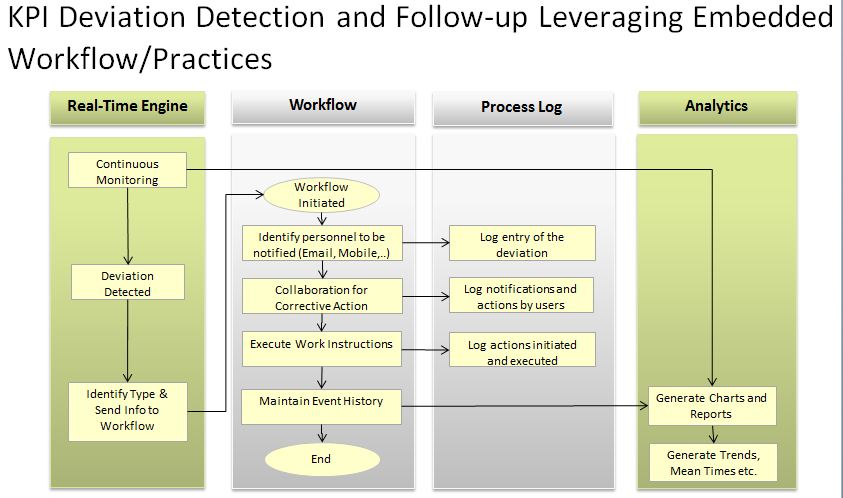
3/ Associated activities and processes that will enable consistent response and action to situations.
4/ Embedded processes in the system to enable consistency of action as workers rotate through roles
 
The rotating worker refers to the growing trend of people staying in a role or location for shorter periods. Example one company stated that they have seen the length of workers in a role or location go from 5 years in 2001, to the tenure now at 8 months. This is a drastic change in anyone's books, but on investigation the other significant change in this company was that the workers in the roles had gone from " baby boomer" to " Gen y" their percentage of late “Gen x” or “Gen y” in the operational workspace was over 40%.
While I believe this to be extreme at this stage, but the clear indicators of what we can expect as we approach 2020 is that 42% of the workforce will be Gen Y. Job tenure will average 2.4 years, but now you add locations and evolution of people within a company, the assumption of experience can not be assumed.
As the executives discussed the need is for alignment across their operations, this means sites, plants, and teams while increasing the empowerment of the worker to make decisions in the now.
 

The example above is an embedded operational process, relative a deviation from a KPI that will guide the workers through the desired process, this independent  the user and worker. So instead of just having information, now a work process is built into the system.
The consistency of the answers and focus on the human factor, and enabling users in the dynamic human market was interesting, a clear indicator that this dyanamic role will be natural paradigm in the future.
 

Sunday, January 27, 2013

Do Traditional Reports have a Role in the Agile Industrial Operations World of today and tomorrow?


This is a question that keeps coming up, and product managers/ engineers keep saying we need reports, but in some many ways they are confused between the past and the reality of NOW decisions today. “Today” the need for “Operational Decision” data which is the status now, and over a short time span, with the ability to discover conditions, causes, through relationships, to make “Now” decisions. These are not traditional reports which display a pre defined period and fixed formate. Also, the concept of Dashboards, predefined Gadgets on the desktop, mobile device that act like tickers. All of this is about empowerment of the NOW and reports do fit this role, so do traditional reports have a future????

Sunday, January 20, 2013

Self Reliance/ Self Servicing are Key Concept as the Hunger for Real Time Data Grows

2013 will see another leap in the amount of people, and different roles, accessing industrial data, and there will be another quantum leap in the amount of data people accessing. The concept of Self Reliance and Self Servicing of the user to empower himself will be key!
“Self-service BI is the idea that any business user can analyze the data they need to make a better decision. Self-reliance is the coming of age of that concept: it means business users have access to the right data that the data is in a place and format that they can use and that they have solutions that enable self-service analytics. When all this happens, people become self-reliant with their business questions and IT can focus on providing the secure data and solutions to get them there.”
“Source Top 10 Business Intelligence Trend for 2013” Tableau software
I have spent a number of hours this week discussing this concept and determining in the industrial sector how to make this a reality as we believe it is key to unlocking the full potential of the industrial landscape.

Wednesday, January 16, 2013

Big Data will Play in 2013, and Reality on an Information System could be in 2013

“The staid old world of databases is developing faster and faster, with startups addressing new data problems and established companies innovating on their platforms. Web-based analytics tools are connecting to web-based data. And everything’s mobile.”
I read a good article whitepaper from a our Partner Tableau for intelligence software they outlined the 10 concepts that are becoming reality in 2012/3.
·         10 Intelligence Concepts :
·         Proliferation of data stores.
·         Forecasting and predictive analytics become common.
·         Mobile BI moves up a weight class.
·         Visual analytics wins Best Picture
·         Cloud BI grows up.
·         The value of text and other unstructured data is (finally!) recognized.
·         Self-reliance is the new self-service.
·         Hadoop is Real
·         Collaboration is not a feature, it’s a reality.

“2013 is the year we will recognize this story as a fairy tale.
The organization that has all its data in one place does not exist. Moreover, why would you want to do it? Big data could be in places like Teradata and Hadoop. Transactional data might be in Oracle or SQL Server. The right data stores for the right data and workload will be seen as one of the hallmarks of a great IT organization, not a problem to be fixed.”
All these concepts align with what we seeing and I will expand on but I thought this could be a good read to many of you, even though it is focused on Business Intelligence this applies to Industrial Infomration Systems:
http://cdnlarge.tableausoftware.com/sites/default/files/whitepapers/top-10-business-intelligence-trends-2013.pdf

Sunday, January 13, 2013

Why design for 2020, not today! What does the “Why Not” and “What If” Attitude mean?

One of the enjoyments of writing a blog is to see the reaction, get the response, they seem to come via email, it is fasinating what topics generate interest and response.  Last week I had a set of emails asking “why care about 2020, when we are focused on today?” Another set asked about the attitude “Why not” and “What If”? Both are fair and deserve further discussion.
So why care about 2020? Why Now?

Sunday, January 6, 2013

A Look at Industrial Operational Management Environment in 2020!!

Lets face it 2020 is only 8 years away, look at 8 years ago: Facebook had barely launched, iphone and iPad did not exit, the A380 Airbus had not flown, and there was no You Tube, Twitter had not taken. Yet today Facebook, Youtube and social media are a natural part of our culture and lifestyle. Iphone has now past MS Outlook as the worlds largest email client, and mobile devices out sell all PC sales, which shows the significant shift in everyday life to always connected with the mobile device, not just for calls, but text, news, email. Imagine doing business today without a mobile being able to access the required information. So in 2020, what will be a natural part of the Industrial Operational Management/ Plant Operations “day in the life”.
Are we designing today's systems for the future, are we looking at work ethic of 5 to 8 years out when designing? The answer is probably not farther than 2 to 3 years this could be a mistake when all the factors are changing so much.