Sunday, June 8, 2014

"Smart, intelligent, brilliant devices" what is key is "self aware" devices

As I listen to “Youtubes," lectures on the Internet of Things, and in industry forums, I hear the terms of " smart, intelligent, and now brilliant" devices, as we move to smart cities, smart farms, smart airports, and smart industrial sites. I asked myself what is the core value and difference?

There is a significant leap and a significant switch from monitoring devices from a high application or humans, to " self aware" devices that monitor their own health and capability. Next you ask the difference between "smart" to " brilliant" devices and interestingly there is even amongst the marketing hype! The level of capabilities associated to the device that takes them from simple "self awareness" of asset health, to predictive and "machine learning" capability to move from the " as is" alarm to "to be " state."

However, it is all increased levels of embedded "self awareness" capability as close to the device or in the device to monitor, and understand it is effective condition to the "golden" operating condition, with the intent to sustain "operational continuity." The key is device level " awareness" and the connection of these devices to the Internet apart of a  holistic system( site, enterprise), raising exception conditions automatically, and acted on in a consistent, and “best practice procedure." With many of the same types of devices can now be aware of each other, learn from each other and grow in "self awareness" capability. Increasing the ability to shift to the "to be " state where exception conditions seen early,  corrective action can be taken fast and early to maintain " operational continuity."

As we go forward the " future" will also be incorporated into the device, eg high fidelity simulation models will be available for common devices, and will learn relative to the particular device setup and situation. Enabling not just the current condition but the future condition window to be seen, and " what if" to be played out but inexperienced operational staff to make well informed and correct decisions. This simulation model will either run locally or be called upon by the device to a remote simulation environment with discrete device models.

All of this device awareness is what I see as a paradigm shift the "Internet of things" brings and the opportunity to the industrial operational space for the next jump in productivity.

I have heard many times, and agree with the Internet of things, "self aware"devices that leverage their "brothers and sister devices" and other intelligence not applications, brings the next step change in output growth and GDP output. Called the "third industrial revolution" where and industrial revolution is when a significant step change in GDP productivity output is achieved, the first two been:

1/ the first industrial revolution with the steam engine, and then self pro population capability for production and transport.

2/ the Internet in 1992 to 2000, and beyond where human communication, collaboration and the " flat world was introduced" switching us from regional to global effectiveness.

3/ the Internet of things" self aware devices, and collaboration between devices, applications and people to address the fast moving world we live in and the requirement of “Now” decisions and satisfaction.

Too often all of this is associated with larger companies and utilities, but last week I visited a small food plant in rural Australia, to discuss their next step in operational change, and competitiveness. Two thought leaders where present, and it was great to have a very active and productive discussion around not problems, but opportunities. Leading to a powerful discussion on discovery investigations around these opportunities, and the key opportunities were again:

1/ People cost, therefore effectiveness

2/People efficiency in a dynamic and changing workforce

3/Brand integrity, and quality

4/Variable costs in materials but now energy

The discussion took us to the operational work space of the future the need for not data, but effective information that enables exception based operational management, supervisory control of the plant, and process.  Shift from process management to product production management, spanning all the processes and production units required to produce a product. A shift to activities that are required in order make the product and enable operational continuity.

The concept of "self aware plant” made up " self aware devices” and " self aware process" with embedded operational procedures was a reality, and not just for big companies, but even more critical for small to medium companies/sites that have fewer resources.


Maybe the new world is not that far away!

Monday, June 2, 2014

Operational Work, Accountability, and the evolution to Activity Design is Fundamental

As I toured customers in North America, Australia and Middle East over the last month, the discussions around operational / supervisory/ automation design have come up. Over and over again the core theme becomes evident that of "activities/tasks" become a core to design vs. the stations and interfaces.
One customer broke their plant up into logical operational/process cells, and then defined not the User Interfaces, and interfaces but the "actions, decisions " that need to be made to operational and manage these cells. The commentary was different from the old days where they would have defined the user interface (HMI, DCS workstation) now they were think "tasks". They believed that they would have "universal" stations on plant floors that could access all "tasks" so roaming people could just go to the closest station to take action, after being notified on their mobile device.
They had made a decision that they did not want control actions to take place from a mobile device, but all information relative to the situation and "task/ activity" can be seen on a mobile device, this is a fair decision.
The clear thinking in the design is that
  1.  No longer is control only local, they have a central control, and roaming workers which all need to see situation and act on " tasks/ activities"
  2. That their operational differentiation in the market is down to their operational processes/ procedures not technology or User Interface.
  3. That these Operational procedures that make up these " tasks/activities" will evolve, and you are not certain who person, role, device, or location this " task/ activity" will be acted upon.


It was good to see the logical, free thinking, and we were able then to go into the design of what makes up an "activity/task." With the key elements being
  1. trigger condition
  2. notification, including escalation to relevant team through the activity lifetime
  3. decision support information
  4. relevant action operational procedure to resolve which could go across multiple people based upon the Resolution Path.

The diagram below shows the seven detail core elements, key is dealing with "emergent work" vs "planned work".


The other point that came up in the discussions was "accountability" so that actions and who owns the decision and action is clear eliminating confusion. " Governance" of the procedure so that it can evolve and managed over time so that it can be tuned, evolved in value over time.
It was good to see a shift in design thinking, but it was clear these are thought leaders, most people in the forums were still traditional approach, yet they talked about the changing workforce. I wonder how you can design a system based upon HMIs and workstations based on location, vs. the "activity" approach when the world will operationally evolve and the concept " operational flexible teams " come into play.

The competitive advantage is based on how fast decisions are made and acted upon, how agile the operational processes and procedures can be evolved, and how effective companies leverage their fixed production assets, and their human operational assets.

Sunday, May 25, 2014

Operational Manufacturing Interface (OMI) vs Human Man Interface(HMI) or SCADA

Over the last year, I have visited many sites, discussed with many peers the evolution of the Operational Experience in the Industrial Landscape. But over and over again I find myself in the much debate on the role and capability, as usual this is not anybody being incorrect it is a miss communication more often than not.

The traditional industrial user experience which has been owned by the Human Man Interface (HMI) or DCS workstation, where people control, monitor and interact with the process in a focused way. So in these discussions people use the HMI, but I find myself questioning what experience are they targeting or describing. More than often I pull up the diagram below to provide a reference for Industrial Operational Experience of today.


 An HMI for a process cell with a narrow focus is very different to the Operational Interface used in an Integrated Operational Center, and very quickly people see the different.
This does not mean the Time of the HMI is over, I fundamentally think it does it's job well, at the focused point at which a process cell and the human come together in a simple, clear and concise experience at a reasonable process to set up and sustain.
But as you move to the right of this diagram, increasing reason-ability, increased scope of control, increased value in decisions. No longer can you monitor the system, the system be an exception based bring to attention the critical items. The focus is on Operational Continuity, which goes beyond control to Optimization and performance, and effective alignment of the operational team. Understanding the operating boundaries set up by safety to humans and environment, and maintaining maximum operational/energy performance.
To achieve this, the user is looking at operational view/dashboard of the high level process with the ability to investigate situations onto surrounding operational view real estate for deeper focus, without losing the overall screen. This avoids missing situations, as this Center view is an exception based.   The ability to investigate and then share with others in the team, easily, and for dynamic live collaboration to exist between the site field staff and operational experts, production, maintenance etc no matter where they are.
The information, types of content used in these investigations are not standard process graphics of traditional HMI, they are to name a few:
Video, alarms, alarm event analysis, forms for data entry, and searching. Reports, documents, live collaboration tools, such as chat, video conference, and operational analysis tools to put events, data in the context of now, past and future for " what if" etc.
Key is the interaction between this content, with ability focus on the main screen and situation, then automatic relations across other content for rapid investigation and understanding is achieved for fast decisions.
This is NOT and HMI in the traditional sense and has caused us to term this new interactive, multi content environment in a new type of operational experience the " Operational Management Interface". This multi content environment will go across the operational control room to roaming expert maybe on a tablet, but different layout experience, and to the site.
The key is the interactive, collaboration experience across multiple content types to enable rapid decisions.
As you design for 2020 and operational workspace required over the next few years and for the next 20 years, ask yourself what is required by role, and activity.

Sunday, May 18, 2014

Information Driven Operational/Process Excellence Set Drive Next Wave in Mining but with a Twist

As I toured a number of the leading mining companies this week, the conversation showed a significant shift from last year from "greenfield" to “brownfield" discussions. Shifting from new plant implementation and speed to full production to how they draw the most efficiency from existing assets. The interesting twist was that the discussion of what was an existing asset:
1/ Fixed assets such as equipment
2/ plant ore assets
3/ mobile assets like trucks, digging equipment
4/ human assets, operators, maintenance and experts

So the strategy was how to tap existing information more than often locked within SCADA trend systems, and other data stores, it was key to extract this data and align these records into effective information. The driving forces are :
1/ minimal impact on the existing systems
2/ speed of delivery of the value
3/ expertise to understand and interpret the value
4/ predictive awareness, pattern recognition

The diagram below again resounded in the discussions.
The key for Industrial Analytic s is the trusted data, and just a historian will not achieve this, the model and validation must be done as close to the source.
The information needs delivery in many cases outside the automation landscape, often in the corporate networks. The key is to use the not APIs but make the connection through an SOA architecture. The service sits on the data source, with configuration, and data delivery built in, but key is low impact and effort.
This is not new, as the enterprise historian has been around for years, but the real difference is the need not just gather data, but to capture the data in a structure,  context, and validation of data that makes sure all stored data through resulting information is in trusted.
You are probably sitting there and saying nothing new! Fair, but the key was how are they going get this structured trusted data, that the concept was to do this as close to the source as possible, and then send through. This means the underlying systems do not change, minimize risk, maximize Lifecycle managed to enable evolution which will happen. Why is this not an IOT service, local and pushing vs polling, “self configuring” ?
Remembering the performance team of experts can be anywhere, and will probably virtual, where sharing, analysis and Modeling is done in offline mode looking for patterns.
As the discussions evolved the architecture evolved, and again the "cloud" came into play, why because the data size will grow, the users are everywhere, and the infrastructure of delivering is now there.
Why not?
The collaborative information, industrial analytics, is going to be foundational for the future of Gen Y teams of analysts experts from different locations and outside the companies.
Standby, as we see some of the optimization learnings from Oil and Gas come over into mining.

Monday, May 12, 2014

Industrial Ethernet/ “Internet of Things” Is it About putting Data in the Cloud? Or Interactivity?

Sorry for missing last week, time seems short when on the road with short flights.
As I fly the final leg home after a month on the road many brainstorming multi day workshops around different strategic thinking, but without a doubt the “Internet of Things’ applied in industrial/ manufacturing space brought up many ideas and many questions.
Certainly the discussion of “Cloud” vs “Internet of things” is it about getting to data from all types of devices and making that more available? Certainly that is one case, but certainly it is not a compelling case.
The “Internet of things” is about self-configuring devices, these could instruments, motors trucks, and mobile devices, fixed and roaming devices. Too many of you the IOT definition I believed was clear, but the workshops showed the confusion between taking and existing industrial application to the “Cloud” connecting through safe but tradition device integration paradigms, vs an interactive “self-configuring” environment of devices and systems, that is a new device integration, management paradigm.
Also, it is important to note it is not just about gathering data from devices to the cloud, and exposing it, the real opportunity comes in the interaction between devices, that the environment make the devices “self-aware” and able to interact. A natural example is that mobile devices of a roaming user is interacting with the other devices in the immediate area. Enabling interacting, and constant awareness and warnings of the current environment state, relative to a stability, and safety. Combine this with ever increasing transformation to managing Operational work vs monitoring, where the “work” or “activity” includes the information, action in the context of “activity”.
The fact that a device is now “self-configuring”, so you can from an IOT system “discover” the devices out there and configure the co-ordination system in the cloud, making other systems aware of them. This is a clear case for segments that are physically distributed such as cities, airports, upstream gas fields, mining, pipelines etc. Where the cost of aligning the devices has been too expensive, now with wireless but even more 4G networks like we seeing in the remote “Pilbara” region on Western Australia, the opportunity for plug and play devices that are “edge/ GPRS” enabled, and IOT enabled can be discovered, configured and aligned. As devices are swapped in and out no matter site the size, the configuration moves from an instrumentation job to anyone. This frictionless experience is key in configuration/ and sustaining. The increased speed of systems, decisions and agility required drives up complexity of systems, but this cannot drive up lifecycle cost, and this can only go away through Self Configuration, enablement of anyone to enable the system to run, this become clear as the key requirement of the IOT.

The chart below shows the expected industry segments to adopt, many are well engaged.

But why is there a slow take up, mainly I believe to unawareness, lack of understanding, and readiness? But this is changing, the IOT platforms are coming on to the market that will drive down the cost of achieving IOT, but it will still be a journey. The diagram below shows from one of the workshops the key challenges in adoption, I expect these to fall away fast over the next 2 to 3 years. I cannot see how we going achieve the agility, with the dynamic market, operational workforce at a sustainable cost that is reasonable without this paradigm shift, to IOT as interactive landscape. In the many sessions I held with end users, engineers and people across the company and industry, the real initial opportunity is not in the big plants it is in the “collaborative Industrial Landscape” of small plants and assets aligning with people and processes.

 Certainly the interest, like cloud is growing, and the infrastructure is maturing that this will be reality in helping to addressing the modern industrial landscape challengers in a very different landscape than we had in 90s, 2000s, and 2010s, I will discuss more on this fundamental event next week.

Sunday, April 27, 2014

Momentum grows on Internet of Things in Industrial and Manufacturing Environment

As I enter another week of brainstorming workshops across Schneider Software, with thought leaders, we are working through innovations on technology, architecture and process. Centered around the “cloud” and “Internet of things” while we have offerings happening in both areas, we need shift from offerings to these technologies be a natural part of the industrial architecture and process of buying and applying an industrial solution. I also spoke with many people over the last 2 weeks across the world not about technology but about the solution challengers and it was clear that the three main challengers kept coming up:
  •  People and operational change of moving to teams which involved remote workers and virtual experts
  •  Agility to change production, and process quickly and efficiently
  •  Holistic control across the manufacturing industrial assets. This required the expansion to   assets that could be mobile or remote to traditional industrial plant, yet still are apart of Value Chain that they are accountable.
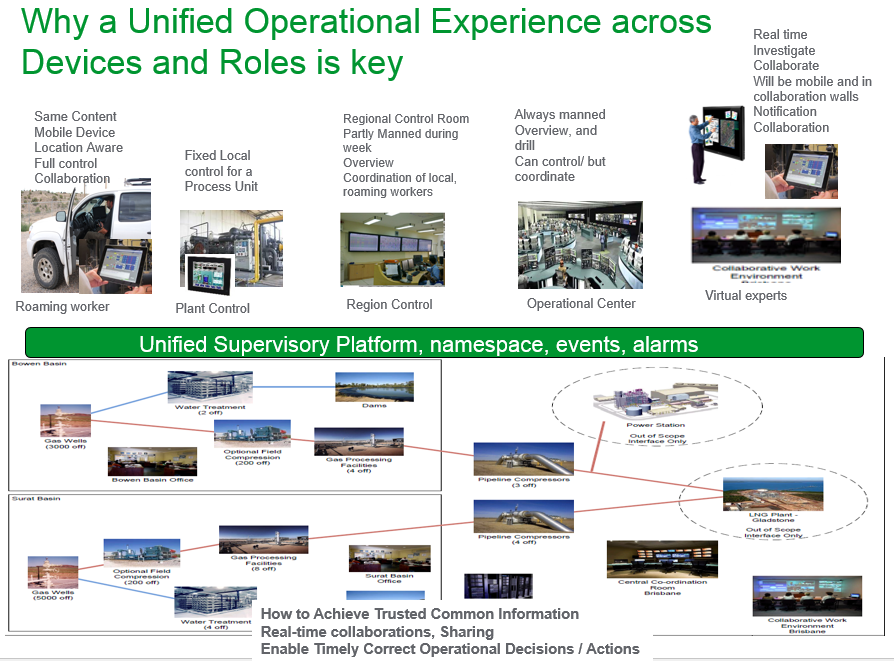
Accountability came up over and over again; this means different things from a safety of people to food safety so trace ability etc to efficiency and responsibility to the environment and impact. It was clear in all the discussions that a change in thinking of architecture and approach was needed but instead of its being a “dream” it is really possible today in a sustainable way using such technologies as Cloud and Internet of Things. The architecture below is an example of distributed, but needing a unified operational experience across roles across devices, and unifying devices.
Also during the week I came across two articles one from Microsoft and another from ARC on Hanover fair both supporting the increased momentum in the market for Internet of Things.


Key as MS  points out below the opportunity to investigate and improve your business by naturally looking beyond the traditional architectures, overcoming the concerns such as security, by implementing secure architectures and approaches “that does not mean isolation”.   
The Operational Transformation is here from a design point of view, again this is one of the technologies and approaches to be employed to achieve the operational workspace and efficiency required in the flat world.

Sunday, April 20, 2014

“Self Service” Data to Information is key to Industrial Analysts

I am on the road for a month always a good opportunity to speak with new people, and again the discussion of access to site information across sites and equipment becomes critical. This requires different tools and different approach , we have also different people involved.
Example I was at dinner with an engineer who runs installation/ tuning team for a wind turbine manufacturer. He talked about how his team follows the installation team, and goes in and sets up the turbine, while I expected the discussion to center on turning and setup of the turbine. The discussion was actually on how they set the data gathering equipment, and making sure the contextualization was in the data, so that he would be able to convert to information through contextualization. This was not a nice to have it was now a natural and critical part of the wind farm set up, as they leave the farm (which is usually in the middle of nowhere) he talked about the second phase of tuning, an analysis phase. This he does with his team anywhere but not at site; they capture the data, and start setting situations, and patterns. Applying past known conditions but he talked about doing this analysis across 10s of wind farms over 100s of turbines from all over the world. This engineer was unaware of what I do, and whom I work for, so the discussion was very candid and interesting to me as I had a mechanical engineer who is Gen Y, and just assumes that this information will be available, and to him it is the critical part of   installation to setup this data acquisition system, so he is empowered to work from where ever he is.
So the next question I tried to understand the type of analysis and clients, profile of people using the information. “Self Service” is the key, and the sense of discovery insight was key, using tools like trends, mat lab and  excel played in for analysis, but key was a set of tools spreadsheet models and analysts that they had built up over time. Notice this was not just talking reporting, dashboards but it was the discovery aspect, the ability to combine different data sources easily e.g. to compare like turbines.
Everything needed to be “plug and Play” allowing turbines to be added by not instrumented people, access to information, and the data from the turbine is not enough the information on the wind farm is key to provide the context situation the turbine is performing in. So orientation, terrain, and weather input for that site, both now, history and future is key. So merging data sources from sites, with other models etc., and then compare from sites to sites to improve and evolve.
But in the discussion it was clear that he and his team are ideal for not storing the data local but going to the cloud architecture, enabling these remote data source sites to gather and push to the cloud, combine with the weather data for that site already in the cloud, and then consume, discover and share from tools and models in the cloud. So the virtual team, virtual sites, can become unified and effective in the collaboration end evolution.   
Time for New Approach to Industrial Information  
It may have been Tom Davenport, noted professor, author, and analytics expert, who first came up with the terms descriptive, predictive, and prescriptive to describe the three stages of maturity for analytics use within an organization:
Descriptive Stage: What happened in the past?
Predictive Stage: What will (probably) happen in the future?
Prescriptive Stage: What should we do to change the future?
The first stage ("descriptive) is the traditional approach with trend analysis, simple tabular reports and dashboards into the descriptive bucket. When applied effectively, these technologies provide visibility into what happened - but only up to a point. Many companies are now also rapidly adopting a third class of descriptive solution, visual data discovery. The reason is simple - it can significantly improve the odds that managers and process engineers can find the right information at the right time.
But, a report of that type is never going to help answer some important questions that may arise, such as: "Why is work-in progress in progress for longer than in the past?” Likewise, an indicator on a dashboard could show current on-time delivery performance. In practice, dashboards are often more flexible than reports enabling users to drill down from summary information to detailed data. This can help managers understand cause and effect. But ultimately, users are still limited to answer those questions anticipated by an IT specialist when he or she first developed the dashboard. And that's the crux of the problem: most current BI solutions still largely depend on IT specialists to create new BI assets (such as reports and dashboards), or to modify existing ones.
Why does that matter? It matters because most decisions have a distinct "window of opportunity." In other words, after a certain point in time, any value to be had from making a decision just vanishes. For example, the opportunity to maximize a load demand, only exists while there is a window of demand, the ability to bring up a set of wind turbines in a timely manner, understanding the landscape across the wind farm, and the weather model for the next 24 hours. When the demand has gone the Window of opportunity and data need has gone, so if it took 20 hours to get that information the opportunity has been lost. In practice, all decisions have a point in time after which they are no longer relevant.
Clearly, something more is required. And for an increasing number of organizations that something is a visual data discovery tool. Visual data discovery tools provide a very visual workspace that encourages process analysis engineers, managers to manipulate data, hands-on. They provide an engaging experience to explore data freeform, with minimal or no help from skilled IT staff. Starting from the first glimmer of a problem/ opportunity users can investigate freely, follow their train of thought, and link cause to effect. That is exactly the type of capability required to furnish answers to unexpected questions – the type of questions that conventional reports and dashboards often struggle to answer.
Visual data discovery tools typically provide:

• Unrestricted navigation through, and exploration of, data, example search
• Rich data visualization so information can be comprehended rapidly
• The ability to introduce new data sources into an analysis to expand and follow it further These factors are at the core of self-service analytics.

As the manufacturing world grows increasingly fast-paced and dynamic, self-service analytics probably offered as a service online; that can be consumed from anywhere, “on boarded” fast, and certain tools only used as needed, will enable a more cost effective, reliable and powerful industrial analysis environment. It is clear to me domain engineers like my friend in Wind Turbines need a platform of tools to build their domain solutions, to deliver a “self-service “ domain solution for Wind turbine tuning, on boarding to really enable the ability to satisfy the dynamic world. As we move to “micro grids” where the expert decision makers with lots of experiences are not available, decisions and actions will need to be enabled through “Self Service” visual domain tools.