Showing posts with label Operational Manufacturing Interface.. Show all posts

Saturday, December 13, 2014

The Industrial Software space continues to outgrow its labels!!!!

As the 2014 draws to a close, I seem to be sitting in a growing amount of long term strategic meetings both within Schneider-Electric and within customers and discussing the landscape of 2020 -2025. What immediately happens is the labels we have used for years for products, spaces, and roles no longer mean the same thing. We rapidly find ourselves setting up a glossary of labels and what they will mean in 2020-25 in order to gain alignment.

Putting a label on this space has been challenging because it has evolved over the last 20 years and will continue to change as many technologies converge towards an integrated industrial software platform strategy.

1990 - 2010: The label “MES” was first introduced in 1990 to refer to a point application at a single site (typically Quality Management). Over the next 20 years, more functionality was added to MES to keep pace with Automation trends.


2010-2015: In recognizing its evolution, some industry analysts have offered new acronyms like MOM (LNS Research), while others have redefined MES as follows:

“For many, MES is no longer a point application, but a platform that serves a dual purpose: integrating multiple business processes within a site and across the manufacturing network, and creating an enterprise manufacturing execution capability.”

-          Gartner Group, Vendor Guide for MES 2012


Sunday, April 27, 2014

Momentum grows on Internet of Things in Industrial and Manufacturing Environment

As I enter another week of brainstorming workshops across Schneider Software, with thought leaders, we are working through innovations on technology, architecture and process. Centered around the “cloud” and “Internet of things” while we have offerings happening in both areas, we need shift from offerings to these technologies be a natural part of the industrial architecture and process of buying and applying an industrial solution. I also spoke with many people over the last 2 weeks across the world not about technology but about the solution challengers and it was clear that the three main challengers kept coming up:
  •  People and operational change of moving to teams which involved remote workers and virtual experts
  •  Agility to change production, and process quickly and efficiently
  •  Holistic control across the manufacturing industrial assets. This required the expansion to   assets that could be mobile or remote to traditional industrial plant, yet still are apart of Value Chain that they are accountable.
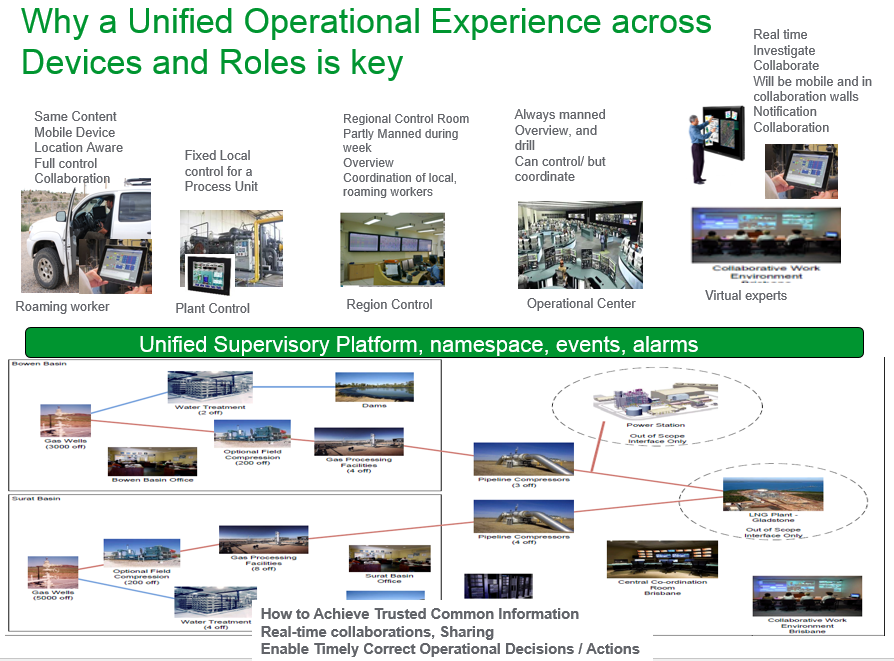
Accountability came up over and over again; this means different things from a safety of people to food safety so trace ability etc to efficiency and responsibility to the environment and impact. It was clear in all the discussions that a change in thinking of architecture and approach was needed but instead of its being a “dream” it is really possible today in a sustainable way using such technologies as Cloud and Internet of Things. The architecture below is an example of distributed, but needing a unified operational experience across roles across devices, and unifying devices.
Also during the week I came across two articles one from Microsoft and another from ARC on Hanover fair both supporting the increased momentum in the market for Internet of Things.


Key as MS  points out below the opportunity to investigate and improve your business by naturally looking beyond the traditional architectures, overcoming the concerns such as security, by implementing secure architectures and approaches “that does not mean isolation”.   
The Operational Transformation is here from a design point of view, again this is one of the technologies and approaches to be employed to achieve the operational workspace and efficiency required in the flat world.